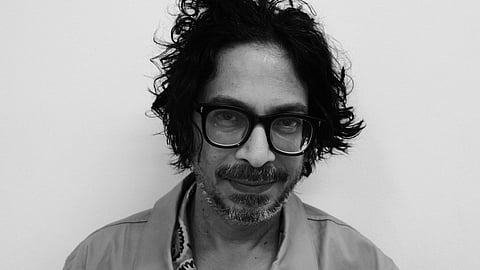

Sarnath Banerjee's Absolute Jafar (HarperCollins) is a reflection of the stories, memories, and experiences of his time in Delhi, Karachi, and Berlin. The book follows Brighu, an Indian, his Pakistani wife Mahrukh, and their son Jafar, who is born in Berlin. It looks at the bureaucratic barriers the Indo‑Pak couple faces and how distance, migration, and uncertainty shape their bond.
In the book, Brighu tells his son bedtime stories—of “distant lands,” princes and princesses, hidden treasures, sultans and jinns; of the Sind Club in Karachi, and of the jinns said to haunt Calcutta’s Bowbazar. Telling those stories, perhaps, becomes Brighu’s way of returning to his old memories. The novel is funny and engaging, yet also full of deep, meaningful observations. In conversation with TMS, Banerjee discusses the inspiration behind the book, his writing process, and more.
Excerpts from the interview:
Q. What was the inspiration behind writing Absolute Jafar?
Writing Absolute Jafar is an act of remembering. Not remembering facts, but remembering how I felt during certain years, and how the characters might have felt during periods of migration and displacement. If I hadn't written this book, I would probably have forgotten those emotions.
The process of writing is both painful and pleasurable because it involves untangling and revisiting the past. In many ways, I wrote the book for myself, as a way of holding on to those memories. What surprised me was how strongly readers connected with it. I realised that everyone has a personal journey they want to articulate.

Q. Although the book is mostly about Brighu and his life, why did you choose to title it after his son, Jafar?
In the Sufi mystical traditions of North India, there is a concept of the Ghayb and the Hazir — the tangible and the intangible. Jafar is an invisible presence that encapsulates the entire book. You don't actually see him much, because he is, in many ways, the theme of the book. But everything happens around him. Brighu would not have been in Berlin had it not been for Jafar. The Indo-Pak relationship that runs through the narrative also finds an outcome in Jafar.
Although the story is largely about Brighu, it is driven by the existence of Jafar. In that sense, Brighu is the Hazir — the visible presence — while Jafar is the Ghayb , the invisible one.
Q. The book begins with the idea of walking and also ends with Brighu walking. Why is walking such an important part of the story?
Walking is often an act of resolving things. For me, long walks are also moments of distraction and discovery. As you walk, you encounter things that become portals into other thoughts and memories. You may be walking through a market, but suddenly your mind travels to your childhood or to a completely different time and place. In that sense, walking is also a way of accessing the past. It allows memories to surface naturally, which is why it became such an important element in the book.
Q. Some parts of the book, especially in the beginning, are in black and white, while much of the latter half is rendered in colour.
Remembering and drawing slows you down. When you draw from memory, you're constantly asking yourself questions: What colour were the walls? How narrow was the street? What did the atmosphere feel like? Memory is imperfect, and that imperfection inevitably enters the drawings.
The shift between black and white and colour is tied to how I remember particular scenes. Sometimes I remember a moment primarily through light, shadow and tonal contrasts. Those scenes naturally become black and white. At other times, colour is central to the memory. Earlier, I wasn't particularly confident with colour and tended to see the world more through tones and tonalities. My son often tells me that my colouring has improved considerably.
Q. Is your own idea of home a definite one? Has writing this book changed your understanding of what home means?
One of the things I enjoy about comics and graphic novels is that they allow for multiple points of view. Most of us are not entirely certain about our beliefs or positions… We are often uncertain about what happiness means, what home means, what gives us security, or even what love is. Comics are a wonderful medium for expressing that uncertainty.
For Brighu, home is Delhi. Even after spending decades in Berlin, raising a child there and growing from a young man into a middle-aged man, he continues to hold on to Delhi as home. But for his son, that continuity may not exist. He may never live in Delhi in the same way.
At the same time, the India that Brighu remembers has changed. There has been this big movement towards a more conservative society—anti-women, anti-caste and anti-minority in many ways. Hence, the book also touches on the fear of returning home, because even a small change in something familiar can feel unsettling. So the book isn't trying to provide a definitive answer about home. It's a contemplation of what home means when people move between countries, cultures and generations.
Q. Many artists see AI as a threat to creative work. Do you think AI can ever create stories with the same emotional depth and complexity as human beings?
When you write something, you also create ghosts. There is a certain haunting quality in literature, art, music and film. Those ghosts emerge from lived experience—from the time spent making the work, the mistakes, the revisions, the moments of joy and frustration. The question, then, is whether AI can create those ghosts.
AI can imitate styles, generate convincing images and produce work that resembles human creativity. In the future, it may become even better at doing that. But replication is not the same as experience.
What AI lacks is the pleasure, struggle, slowness and uncertainty that go into making something. The joy of finally getting a drawing right, the frustration of discarding a page that doesn't work, the years spent thinking about an idea—those experiences become part of the work itself. So while AI may be able to create a simulacra of an emotion, I don't think it can replicate the human experience that produces those emotions in the first place.
Art is not only about the finished product. It's also about the process. AI is designed to optimise and accelerate outcomes, whereas many creative activities derive their meaning from the time spent doing them. Whether it's writing, drawing, gardening or playing badminton, the value lies in the act itself.