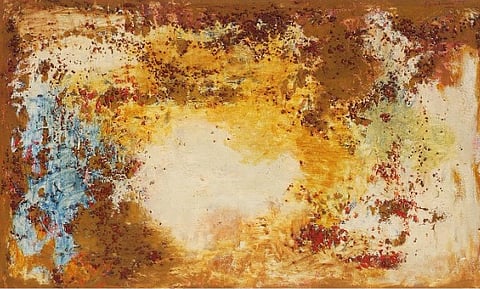

At 90, Ratan Parimoo is finally seeing his journey as a painter brought into sharper focus. The exhibition ‘Grammar of Seeing’, on view at Gallerie Splash, brings together decades of his work from the mid-1950s to 1980s in one of the most comprehensive presentations of his art to date.
‘Grammar of Seeing’ has been curated by Satyajit Dave. It features paintings, drawings, prints, collages, archival photographs, letters and personal writings from nearly three decades of Parimoo's artistic journey. Running until July 15, the exhibition traces his evolution from a young student painting Kashmir's landscapes in the 1950s to an artist developing an abstract language of his own.
The exhibition seeks to fill an important gap in Indian art history. "Very few people are aware of his contributions to painting," says Dave. "He was first trained as a painter under N.S. Bendre [founder of the Baroda Group and known for his landscape work], before becoming an art historian."

Learning to see
Another major section is devoted to Parimoo's years at the Courtauld Institute of Art in London, where he studied art history in the early 1960s. Paintings, letters and archival documents from this period reveal an artist engaging with international ideas while continuing to refine his own visual language.
The retrospective further showcases archival material related to the Baroda Group of Artists, founded in 1956 by Bendre along with artists including Jyoti Bhatt, Shanti Dave and Parimoo. Many of these documents are being displayed publicly for the first time, offering fresh insights into the development of modern Indian art.
As the exhibition's title, ‘Grammar of Seeing’, suggests, it is concerned not only with what Parimoo painted but also with how he saw the world. According to the curator, seeing is a far deeper act than simply looking, involving one's experiences, learning and interpretation. While the subjects and styles changed over the decades, Dave notes that Parimoo's way of seeing remained consistent. Each new phase of learning, he says, polished the artist's ability to look beyond the surface and develop new forms of visual expression.
Learning to see
Another major section is devoted to Parimoo's years at the Courtauld Institute of Art in London, where he studied art history in the early 1960s. Paintings, letters and archival documents from this period reveal an artist engaging with international ideas while continuing to refine his own visual language.
The retrospective further showcases archival material related to the Baroda Group of Artists, founded in 1956 by Bendre along with artists including Jyoti Bhatt, Shanti Dave and Parimoo. Many of these documents are being displayed publicly for the first time, offering fresh insights into the development of modern Indian art.
As the exhibition's title, ‘Grammar of Seeing’, suggests, it is concerned not only with what Parimoo painted but also with how he saw the world. According to the curator, seeing is a far deeper act than simply looking, involving one's experiences, learning and interpretation. While the subjects and styles changed over the decades, Dave notes that Parimoo's way of seeing remained consistent. Each new phase of learning, he says, polished the artist's ability to look beyond the surface and develop new forms of visual expression.
The value of persistence
Reflecting on the exhibition's significance, Parimoo notes that it offers an opportunity to revisit aspects of his artistic practice that had received less attention over the years. "If one has had an experience in one's life as an artist not given his proper due, this exhibition particularly compensates for that feeling," he says.
While speaking of the lessons art has taught him over a long career, Parimoo stresses the importance of persistence and persistence with one's medium. Comparing an artist's practice to a musician's riyaaz, he says that artists must continually work with their materials, learning through experimentation and repetition. "Using the material continuously would be something like the riyaaz of the musician," he adds. Such sustained practice, he adds, helps artists discover new possibilities and gives way to their creative direction.
For young artists, his advice is straightforward: "Be involved in handling the material all the time. And most of all, be persistent."