
Delhi can be said to be as old as history itself, with every nook and corner of the city breathing a legacy lost in time. One can casually pass by a tomb and not know how many battles were fought to inherit that piece of land.
Dynasties after dynasties fancied Delhi, and each emperor left his mark etched in time—some of which now lie in neglect. From the Mahabharat to the Mughals to Mahatma Gandhi—City of Djinns has regenerated itself no matter how many times it was destroyed.
The centuries old broken heritage seeks repair as tombs gather dust and legendary parks have been reduced to resting spots.
The Municipal Corporation of Delhi (MCD) is set to begin a phased restoration and preservation exercise for eight Grade I heritage structures, with conservation work expected to start next month. The Grade I category denotes monuments classified as being of the highest historical importance.
Lost legacy of Zamrudpur
As you drive through the manicured lanes of South Delhi, where bougainvillaea spill over gates and luxury bungalows demand a second glance, it is easy to believe the city is neatly composed, its past carefully curated. But then, without warning, a left turn breaks that illusion. The road narrows and fractures.
The road further gives way to a broken stretch dotted with cycle repair shops, a modest grocery store, and a small stall serving chapatis with aloo sabzi under an old peepal tree. The air changes. So does the rhythm. You are in Zamrudpur now—a part of posh South Delhi that feels like a pocket of rural Uttar Pradesh.

Two young boys, idling in the heat, cigarette smoke curling lazily around them, offered directions with an ease that came from belonging. “Yahan ke hi hain,” they said with quiet pride. They led us not to monuments framed by ticket counters and plaques, but to something far more unsettling – four forgotten tombs, scattered across lanes too narrow to barely stretch one’s arms in.
The first tomb does not announce itself. You might pass it without ever knowing it exists. Its dome, once distinct, has faded into the colour of its surrounding four-storey matchbox houses. Wires hang loosely across it like a net, and a broken tree branch juts out of the structure, wrapped in red threads, clearly an attempt, perhaps, to sanctify what has long been neglected.
Garbage spilling from the top and gathered underneath: torn clothes, plastic waste, empty alcohol bottles, cement sacks and what-not. The stench is immediate and unforgiving. People walk through it as if it were just another passageway. For those living in the adjacent buildings, their balconies open not to a view, but to a slow decay.
The second tomb is harder to find and harder to face. It sits buried within dense residential construction, almost erased from sight. From the ground, it is invisible, almost like an abandoned place. You have to climb to the fourth floor of a nearby building to have a glimpse of it. What you see then is not grandeur, but a shadow of it.
The space feels damp, closed, almost suffocating. It has been repurposed into storage, perhaps, or a hiding place, as a bucket and mug could be seen from the gate. There is something about it that keeps people away, not out of respect but discomfort; the staircase just two steps away from the tomb’s entry is also dark – no lights, no sound. All rooms were locked from inside. All you could hear were fans and coolers.
The third tomb stands beside a small Shani temple, and unlike the others, it still carries traces of its former elegance. Its dome raises higher, its pillars more ornate, its interior more detailed. But even here, history has been absorbed into daily life. Clothes hang across its edges, turning it into a communal drying space.
A tree branch emerges from its boundary wall, and beneath it, small idols have been placed, transforming the spot into a site of quiet worship. Gopal, a passerby, watched it with a mix of resignation and frustration. “Sarkar kai dafah aati hai yahan, bas photo leke chali jaati hai… in logon ko kaun hatayega yahan se?” he said.
A local postman, who has worked in Zamrudpur for over two decades, who pieces together fragments of understanding led the way through the labyrinth, explaining in passing, “Yeh makbare nahi the waise… ghodon ke liye jagah thi.” According to him, these structures were meant for horses, not for burial, and perhaps that is why their neglect has never sparked outrage. “It is not a place of worship,” he shrugged as if that alone explained everything. Around these domes, families have built their lives, kitchens tucked into corners, and storage spaces carved out.
The fourth tomb sits near the bada chaupal, and from the outside, it appears as just another large structure built in that era. But as we stepped inside, the scene shifted again. It is a cattle shelter. Under the dome, a cow named Nandini sits beneath a temporary fan and a bulb, creature comforts in a place once meant to signify permanence. The space has been divided into two with a wall: one half for cattle and the other for waste storage.
Prem Pal, 55, who owns the cattle, said that it has been theirs for generations. For him, the tomb is not a monument; it is inheritance. When told that the government plans to restore these domes, he did not hesitate. “We will take it to the court then,” he said. These structures date back to the time of Sikandar Lodi, built by an Afghan noble, Zamrud Khan, who was granted the jagir of Kanchan Sarai, later renamed Zamrudpur. What remains today is not just architecture from the Lodi period but a layered story of how cities forget.
According to National Mission on Monuments and Antiquities, these tombs have deteriorated significantly over time, their visibility reduced by unchecked urban growth. In Zamrudpur, history does not stand still. It is lived in, built over, and repurposed.
Town Hall stands tall
Located in the heart of Chandni Chowk, the historic Town Hall and the adjoining Company Bagh are among the most significant remnants of the city’s colonial-era urban landscape. Built between 1861 and 1866, the Town Hall served as the headquarters of the MCD for nearly 150 years before the civic body shifted to the Civic Centre in 2012. Since then, the heritage structure has remained largely unused and has gradually fallen into disrepair.
In recent years, however, there has been renewed focus on restoring these landmarks as part of a broader effort to revive the heritage character of Shahjahanabad and strengthen tourism in Old Delhi.
Reminiscent of colonial architecture in Delhi, the structure stands in structural deterioration, including water seepage, damaged plaster, and weakening of certain sections of the building. Conservation experts have repeatedly stressed the need for urgent restoration to prevent further damage. The premises are gathering dust, as the MCD has closed them for public view.
The articles kept inside the library of the MCD are paused in silence. The restored complex is expected to house an immersive museum and interpretation centre dedicated to the history of Shahjahanabad. Authorities are also exploring the possibility of hosting cultural programmes, exhibitions, craft markets and public events on the premises, ensuring that the building remains vibrant and financially sustainable.
Neglect of Company Bagh
Officially known as Bagh Deewar Park, Company Bagh is a historic 6.2-acre public park in Old Delhi. It offers you a peaceful walking space with a memorial and Gandhi statue, but its heritage is lost in neglect.
Authorities are expected to upgrade Company Bagh and integrate it with the restored Town Hall precinct. Urban planners envision the area as a heritage-friendly public space where visitors can relax, attend cultural events and appreciate the architectural character of Old Delhi.
The restoration of Company Bagh is closely linked to the future of the Town Hall complex. Situated in front of the building, the historic park once served as an important public gathering space for residents and visitors.
Over time, however, inadequate maintenance, encroachments and increasing urban pressure have diminished its appeal. The park today requires landscape improvement, better pedestrian facilities, enhanced lighting, conservation of historical features and improved maintenance systems.
Silence of Maharaja Agrasen Park
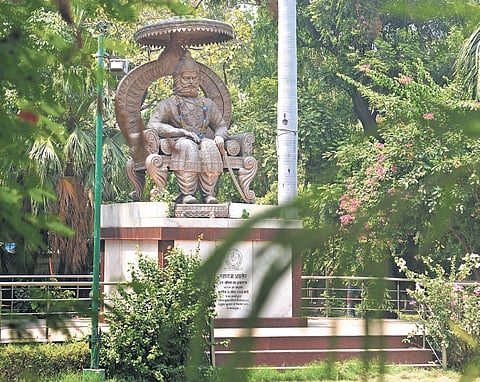
Named after the legendary king of the Suryavanshi dynasty Maharaja Agrasen, the green park finds momentary relief for many commuters who sleep or take rest under the shades of the tree.
A huge statue of the king sits right in the middle of the park, but the gates around it are locked—you can’t go near the statue. “The area around the statue has been locked since the past 3-4 months after a major fight between some men in that area,” said Pramod, the gardener in the park.
The park has three entry/exit gates and is open to the public from 7 am to 6 pm. There is one guard who sits at one of the gates and about 10-12 gardeners. Pramod points out, “The main problems are cases of snatching and daylight robbery.
The cases have seen such a rise nowadays that police have closed the area around the statue and keep a check around the park.” On one side of the park is a small hall-like setup where events are hosted often. While setting up the hall for an upcoming event,
Ramesh, another gardener from the park, says, “Most events here are conducted by the area’s municipal councillor.” People sat and rested under the shades along with stray dogs, who seemed to have found a slight comfort in the ‘king’s’ park.
Kali Gumti breathes alone
Another monument under MCD’s restoration plan is Kali Gumti. Situated inside the famous Hauz Khas Deer Park, the monument holds an unperturbed appearance as it sits there for years. According to Islamicheritage.com, “It is believed to have been built during the reign of the Tughlaq dynasty; this structure is characterised by its simplistic architecture and historical significance.”
While modest in size, Kali Gumti contributes to the rich historical tapestry of the Hauz Khas area, reflecting Delhi’s layered history of Islamic architecture and urban development under the Sultanate. Its name, “Kali Gumti”, likely refers to the dark, solemn look of the tomb (“kali” meaning “black” or “dark”). Made in the shape of a square with four openings, the tomb was built during the Lodi period. There are arched openings ending with a mihrab on the west. The Square Chamber is roofed by a dome. Just beside the tomb is a wall mosque.
As one walks around the tomb, packets of food and cigarette packs can be seen thrown across the ground, reflecting the poor state of cleanliness around the monument—once a centre of heritage. Today, the area surrounding the structure is frequented largely by groups of friends and couples. The park has become a preferred spot for those seeking privacy, with many spending time under the shade of its trees to escape the city’s relentless heat.
The neglected monuments depict the city’s indifference to its past that it has mostly taken for granted. The citizens need to reclaim the history before the ruins are reduced to dust. The civic body’s restoration initiative comes only after directions from the Supreme Court to restore heritage monuments under the MCD’s ownership.
However, there are a thousand other relics of the past in the city that crave attention while suffocated in encroachment and misuse. As we move ahead, it’s time to know our stories better and restore these silent witnesses of history. Only then will the structures continue to tell Delhi’s story for generations to come.