
"A piece of wood may stop burning, but an ember remains alive beneath the ash,” . One gust of air is enough to reignite it," notes theatre director Nikhil Kumar. For him, that image encapsulates the memory of the anti-Sikh violence in ’80s Delhi.
His upcoming play, 'EMBER', which premieres at Studio Safdar on June 27, revisits the anti-Sikh massacre that followed the assassination of Prime Minister Indira Gandhi on October 31, 1984. Rather than focusing on the violence itself, the production looks at the lives of those who survived and the memories they continue to carry more than four decades later.
Presented as a stage docu-drama, the play follows a PhD scholar researching social violence and survivor experiences. Through a series of interviews and testimonies, the audience is introduced to stories of loss, resilience and life after the riots.

"When we began working on the project, we were focusing on one story and one character," says Kumar. "Later we decided to make it a stage docu-drama so we could show multiple experiences instead of a single narrative."
The play unfolds through three story arcs. One of the arcs explores life inside Delhi's widow colonies, where many women who lost family members during the violence were resettled. Another follows a family whose ordinary day is disrupted by the outbreak of violence. The third combines fictional scenes with testimonies inspired by real accounts collected from survivors and their families.
"Everyone wrote about how many people died," he says. "But nobody took care of those who survived. For those who survived, life had actually become hell."
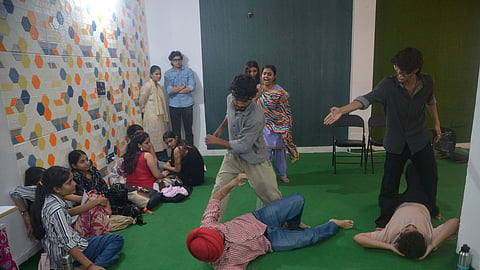
From the rehearsalStill burning
The title of the play emerged from Kumar's engagement with the work of writer and playwright Sardar Sarbpreet Singh, known for documenting Sikh history and memory through books and performances.
"In one of his interviews, he said that while we cannot change what happened in 1984, we can acknowledge it. As generations change, people need to know what happened, why it happened and how brutal it was," recalls Kumar.
The word ember reflects how memories of 1984 continue to exist beneath the surface. "If you go to Trilokpuri and speak to a widow who lived through that time, she may not say much at first. But once she starts talking, she begins reliving those memories. People think 40 years have passed and the story is over, but for many survivors it is not."
Part fictional, part real-life, the play draws from conversations with survivors, voice recordings and accounts collected by Sikh students involved in the production. Kumar asked them to speak with grandparents, relatives and neighbours who had lived through the violence. "I wanted to know what happened, how they felt and what life looked like afterwards," he says.
Memories passed down
One of those students is actor Simranjeet Singh, whose family experienced the violence firsthand. Growing up, he heard fragments of those stories at home, though they were rarely discussed openly. He learnt about the 1984 violence at the age of eight while studying about Indira Gandhi and her tenure in school.
His family lived near Laxmi Nagar during the violence. Through relatives, Singh heard stories of neighbours protecting Sikh families, children being hidden for safety and the fear that spread through entire neighbourhoods.
He recalls hearing about his grandfather narrowly making it home before violence erupted and about his uncle, then a child, being saved after his hair was chopped in a marketplace to avoid being identified as Sikh.
At the same time, stories of loss and displacement left a lasting impact on the family. "Trust in the system was broken," Singh says. "A lot of people felt abandoned."
For Singh, working on EMBER also changed his own understanding of 1984. While he was aware of the broad history, he says researching the production exposed him to stories of brutality and loss that he had not previously known in detail. "I didn't realise how much hatred and violence people had experienced," he says.
While for Kumar, theatre and staging the play offers a way to keep those memories alive. "Films and documentaries exist, but a live performance creates a different connection," he says. "When people witness pain and suffering on stage, it stays with them."
He does not claim that the play uncovers a hidden chapter of history. Instead, he hopes it encourages audiences to acknowledge what happened and listen to those who are still carrying its memory. "We cannot change what happened," Kumar says. "What I can do as a theatre artist is to tell these stories and show the pain and suffering of the survivors."
‘EMBER’ will be staged at Studio Safdar, Shadipur, on June 27 at 5 pm. Tickets are available on BookMyShow.