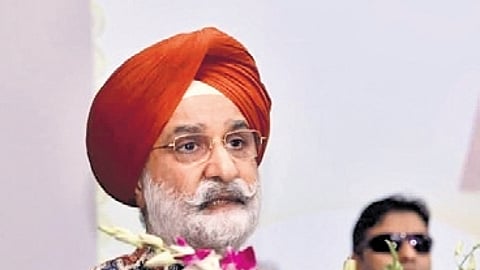

NEW DELHI: Lieutenant Governor Taranjit Singh Sandhu on Saturday addressed the students at the inauguration and orientation programme for the postgraduate programme (PGP) batch 17 at the Indian Institute of Management (IIM), Rohtak.
Speaking to the new cohort, faculty, and parents at the institution, the L-G highlighted that an induction into a premier management institution is not merely a welcome but a crucial introduction to a broader way of thinking.
He said, “To be a leader, you have to believe in yourself first; leadership is about clarity of thought and communication, not about imposing authority.” Sandhu reiterated that this philosophy is central to management education, where true leadership emerges from adaptability and the ability to inspire trust.
Setting the context of India’s rapid developmental trajectory, he noted that the nation is simultaneously scaling infrastructure, expanding digital systems, and responding to the aspirations of one of the world’s youngest populations.
He emphasised that in India, a managerial decision is rarely just an isolated business choice; it deeply affects employment, social mobility, urbanisation, and broader public outcomes.
Highlighting the increasing convergence of technology, healthcare, logistics, and governance, Sandhu stated that the line between public and private domains is continuously blurring. Consequently, he stressed that modern institutions require leaders who can think fluidly across sectors rather than operating within rigid silos.
He expressed strong confidence that the incoming students will utilise their knowledge, innovations, and integrity to contribute to the making of a Viksit Bharat by 2047.
Reflecting on the evolving nature of the discipline, the L-G stated that management has transitioned from traditional optimisation, efficiency, and resource allocation to exercising sound judgement in a highly complex world.
He noted that today’s leaders must navigate uncertainty, geopolitical shifts, and demographic changes while demonstrating resilience, legitimacy, and social responsibility.
