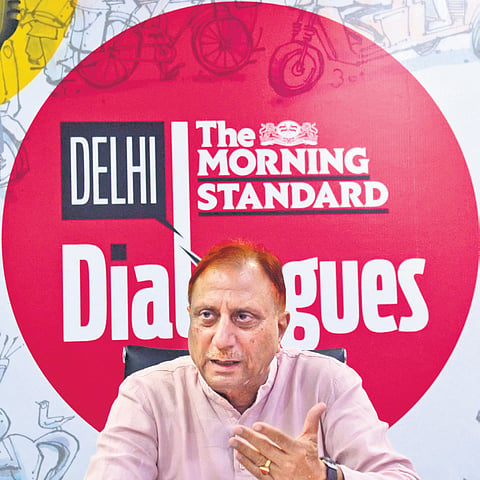

With the BJP in power at the Centre, in Delhi and in the Municipal Corporation of Delhi (MCD), mayor Pravesh Wahi believes that the city is in a position to accelerate long-pending civic projects, especially the ones related to waste management and sanitation. In the “triple-engine government” set-up, Wahi said Delhi residents have already started seeing the benefits with improvements in garbage disposal, financial stability within the civic body and faster execution of development works.
At the centre of his vision is removal of Delhi’s mounting landfill sites. During Delhi Dialogues, an interaction organised by The Morning Standard, Wahi said his primary objective as mayor is to ensure that the city stays clean without mountains of waste becoming eyesores at the its various entrance points.
“The mountains of garbage have become our identity, and we must change that. Once upon a time, there were heaps of trash in every part of the city; today just 20% of those dumps remain. Several dumps have been closed in Rohini, Pitampura and Shalimar Bagh. The compactors have been installed in them,” he said.
Bus terminal at waste landfill site
The mayor pointed out that the MCD has made significant progress in reclaiming land at the Okhla landfill site, which has long remained one of the capital’s biggest environmental concerns. The landfill spans around 62 acres, of which nearly 25 acres have already been cleared through biomining and waste processing.

After visiting the site recently, Wahi stated that he was satisfied with the pace of work and claimed that new machinery has also been installed to scientifically process fresh waste reaching the landfill. He said that plans are afoot to complete the disposal work at the site by December.
However, the reclaimed land cannot be entirely converted for public use, he said, because National Green Tribunal norms require a portion of the area to continue functioning as part of the city’s solid waste management infrastructure.
“Around 30% to 35% of the land will continue to have solid waste management facilities, but the civic body is planning public utilities on the remaining land, such as parks, playgrounds, and hospitals,” he said. Similar efforts are underway at other landfill sites, he added.
According to him, work at the Ghazipur landfill has been the most challenging because of local conditions and its proximity to a slaughterhouse. He said that the Delhi government proposes to develop an inter-state bus terminal at the reclaimed Bhalswa landfill site.
“When people enter Delhi from Haryana, the first thing they see is a mountain of garbage. That should change,” he said. However, for Wahi, remediation alone will not solve Delhi’s waste problem. He repeatedly emphasised that segregation of household waste is the single most important reform needed to transform the city’s sanitation system.
“If the public starts separating wet and dry garbage, nearly 80% of Delhi’s garbage problem will end,” he said, adding that segregated waste can be processed more efficiently at waste-to-energy plants, reducing the burden on landfills while generating electricity. He also noted that the MCD receives a share of revenue generated through waste-to-energy processing and is working towards increasing it.
Meanwhile, in order to improve compliance, the MCD has begun a citywide awareness campaign involving NGOs, councillors and civic officials, who are being asked to visit households and encourage residents to separate waste at source. He also referred to recent directions from both the Union government and the Supreme Court that have made waste segregation mandatory.
Drawing comparisons with cities such as Indore and Gangtok, Wahi said that the public behaviour also needs to change. He said, “In places like Indore or Gangtok, if someone throws garbage indiscriminately, there are strict penalties. In Delhi, we hesitate to impose fines, because we fear backlash. But public participation is equally important if cleanliness has to improve.”
Govt and MLAs chip in with funds
One of the biggest changes over the past year has been the improvement in MCD’s finances, the mayor stated.
While recalling the financial difficulties faced by the civic body in previous years, he said delay in fund releases had severely affected its functioning. At that time, salaries of Group C and Group D employees were often delayed by over two months, leading to protests that affected day-to-day municipal services.
With the Delhi government and the MCD under BJP, coordination between the civic body and the government has improved significantly, allowing development works to proceed smoothly. He said the use of Delhi government funds and MLA allocations has contributed to faster execution of civic projects.
Additionally, the property tax collection has witnessed a substantial increase without raising tax rates. “In the last financial year, property tax collection increased by about `1,100 crore. We did not increase tax rates. In fact, rebates were given in several categories,” he said.
He attributed the finance hike to improved compliance and new schemes of the MCD, adding that the civic body still has scope to expand its tax base. Among the measures announced in the latest budget, he referred to rebates for housing societies and concessions for residential properties of up to 500 square metres in villages. Additionally, the pension-related dues and retirement benefits, which had remained pending for many employees in previous years, are now being cleared regularly.
Beyond finances, Wahi said the MCD has made progress in routine civic operations, including drain desilting ahead of the monsoon. He claimed that nearly 95% of desilting work has already been completed.
Hospital upgrades as policy backbone
The mayor also outlined the MCD’s plans for strengthening education, healthcare and civic services, arguing that improvements in the corporation’s financial position have enabled it to focus on long-term investments.
Currently, the MCD runs primary schools catering to nearly 6.5 lakh students with around 22,000 teachers, many of whom come from slum clusters and unauthorised colonies. He mentioned that the civic body has shifted to direct benefit transfer (DBT) for providing money towards uniforms and books, ensuring that funds are credited directly into parents’ bank accounts.
While referring to educational initiatives, Wahi said the MCD has begun exposing students to museums and science institutions. He mentioned an arrangement under which groups of MCD students are being taken to the Prime Ministers Museum and Library and the Nehru Planetarium, with free entry being facilitated on one day every week for around 200–300 children.
In terms of healthcare, Wahi said the civic body has no shortage of funds for running hospitals and dispensaries and is planning to expand its existing facilities. Expansion work is being planned at Hindu Rao Hospital and Swami Dayanand Hospital with the support of the Delhi government, while maternity facilities at Balak Ram Hospital are also proposed to be strengthened. Wahi said the MCD is working on establishing a modern hospital under the public-private partnership (PPP) model near the RBT Hospital, adding that the project plan is already ready.
After the Supreme Court’s recent directions concerning stray dogs, the MCD has begun work on a shelter near Dwarka with capacity for around 3,000 animals after securing land from the Airports Authority of India. Similar shelters, he said, are planned in every municipal zone, while sterilisation and vaccination drives have been intensified. He clarified that the focus would remain on housing dangerous or biting dogs, while complying with the court’s direction that stray dogs should not be killed.
Parking in the neighbourhood
As the city continues to grapple with traffic congestion and shortage of parking, Wahi said, rather than relying entirely on large multi-level parking structures, he favours creating several smaller neighbourhood parking facilities that can accommodate 50 to 100 vehicles. As of now, nearly 25 to 30 such sites have been identified. He mentioned that parking facilities have been developed at Madhuban Chowk in Pitampura, and another site has been identified in Rani Bagh.
While the city has constructed multi-level parking facilities at Punjab Bagh cremation ground and GK I, Wahi suggested that smaller facilities may offer a practical and quicker solution for residential neighbourhoods. “Parking operators have become a big mafia,” he remarked saying that better coordination with the police would be necessary to regulate illegal parking operations and improve enforcement.
Talking about air pollution, Wahi described the problem as multi-dimensional, pointing to vehicular emissions, construction activity, crop residue burning, weather conditions, garbage burning and the use of coal-fired stoves at roadside establishments as contributing factors.
He pointed out that the Delhi government has introduced hundreds of buses to encourage public transport while mechanised road-cleaning vehicles equipped with sprinklers and dust-suction systems are being deployed to suppress road dust. Further, calling for stricter enforcement against open burning of waste and other polluting activities, Wahi said a coordination of behavioural change, cleaner technologies and penalties would be needed if Delhi hopes to improve its air quality.
In response to concerns over long queues at commercial toll plazas along Delhi’s borders, Wahi acknowledged that traffic congestion adds to pollution and said the civic body would explore increasing the number of toll lanes.
He also said infrastructure projects such as the Urban Extension Road (UER) and the Kundli-Manesar-Palwal (KMP) Expressway have helped reduce the volume of traffic entering the capital. The mayor also acknowledged that the MCD continues to face manpower shortages, particularly after retirements.
Instead of relying solely on fresh recruitment, he suggested that the civic body intends to continue using a combination of permanent staff and private agencies.
Vision for a cleaner Delhi
Wahi envisions initiating projects that leave a lasting impact even when a mayor’s tenure is limited by law. Apart from eliminating Delhi’s garbage mountains, he said the MCD plans to modernise hospitals, develop civic infrastructure, improve parking facilities and continue strengthening sanitation services. He also talked about plans for the redevelopment of the historic Town Hall building in partnership with the tourism department, saying an agreement has already been signed though there is no timeline yet on the long-pending Heritage Museum project.
Eventually, coming back to the subject that dominated much of the conversation, Wahi said the city’s transformation ultimately depends not only on government agencies but also on public participation.
For him, Delhi’s civic future, he suggested, will be judged less by promises and more by whether residents eventually stop associating the capital with overflowing landfills and instead see it as a city defined by cleanliness and efficient urban governance.
Target Landfills
MCD has set an ambitious target of flattening three major landfill sites in the capital
Bhalswa landfill is targeted for flattening by December 2026, and there are 26 lakh metric tonnes (LMT) of waste still remaining to be processed
Okhla landfill has 18 LMT of waste remaining with the same deadline of December 2026
Ghazipur landfill will be the last one to be flattened. It has 67 LMT of waste remaining with a proposed deadline of December 2027