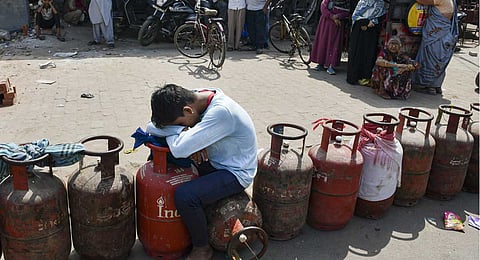

The global energy crisis caused by war in West Asia is having an unusual fallout. We are halfway through the Chaitra Navratri, a period when a large number of people observe fasts, the cost of food for fasting (not to be confused with fast food) is sky rocketing. Items such as potato chips, sabudana papads, roasted peanuts, and other vrat (fast)-specific eatables have either become expensive or disappeared from shop shelves.
What appears at first to be a seasonal shortage is in fact linked to a larger crisis, the disruption in fuel supply, particularly LPG, which is used for preparing and packaging these items. Traders point out that the shortage is not because raw materials are unavailable, but because production has slowed.
Small manufacturers and food processors, who depend heavily on LPG cylinders, are unable to procure fuel at normal prices. With domestic cylinders difficult to obtain and commercial cylinders becoming prohibitively expensive, production has been cut down, and the shortage is now visible in the market. Thus, a war thousands of kilometres away is determining what reaches the fasting plate of a household in Delhi.
The crisis is also visible in another, more telling indicator. The price of upla (cow dung cakes used as fuel) has doubled in parts of the city. In a metropolis that aspires to be counted among global cities, the revival of such traditional fuel sources exposes the fragile foundation of its urban systems.
For many migrant families, whose cooking arrangements are dependent on LPG cylinders sourced through grey markets, the sudden rise in cylinder prices to Rs 3500–4000 has made them unaffordable. In comparison, spending Rs 300 per kilogram on uplas appears to be a practical, if regressive, alternative.
While we have had the newspapers carry the information of the demand for induction stoves skyrocketing, there is another revolution happening, the barbeque revolution in the kitchens. The fancy barbeques used during the year-end party times and then kept away safely are back in action. While some are electric powered, the others mostly run on coal or charcoal. No wonder the coal prices too are soaring. What was once a symbol of leisure has quietly become a survival tool.
These developments together present a striking picture of the urban condition. In the same neighbourhood, one household may be cooking on piped natural gas, another on an induction stove, a third on coal, and yet another on cow dung cakes. The contrast is so stark that it blurs the distinction between a modern metropolis and a rural settlement.
Delhi has long used the term “urbanised village” to describe those villages whose agricultural land has been absorbed into the expanding city while their basic infrastructure remains unchanged. The present crisis suggests that the term may apply to the city itself. Beneath the image of flyovers, metro lines, and glass buildings lies a system that can quickly revert to improvised and traditional methods when supply chains are disturbed.
This raises a larger question about the meaning of being a global city. Globalisation is often understood in terms of connectivity, investment, and consumption, cities competing to host international events. However, globalisation also means exposure to global disruptions.
If a city wishes to be part of the global economy, it must also prepare to handle global crises. This is where planning and governance come into focus. The Delhi government, like other state governments in the National Capital Region, has departments of civil supplies, food, and consumer affairs. These institutions are meant to monitor availability of essential commodities and ensure that shortages do not turn into panic.
Yet the present situation suggests that contingency planning is either inadequate or absent. There appears to be no clear mechanism to manage sudden disruptions in fuel supply, no buffer strategy for small manufacturers, and no coordinated response across the NCR, even though the region functions as a single economic unit.
In India we build roads, housing colonies, and commercial centres but we rarely ask how the system will function under stress. The energy crisis has shown that a city’s strength is not measured only by its skyline, but by its ability to keep its kitchens running when global events take an unexpected turn.
Sidharth Mishra
Author and president, Centre for Reforms, Development & Justice
