
The ongoing conflict between USA, Israel and Iran has resulted in a global energy crisis, with the energy crunch being felt in Delhi’s kitchens. As the ongoing conflict has disrupted international supply chains and maritime trade routes, India is grappling with a liquefied petroleum (LPG) crunch. Commercial cylinders are becoming expensive and scarce, straining the supply lines. But in the national capital where feeding the hungry is a necessity and a long-standing practice, kitchens continue to function- with cooks, community groups and vendors finding novel ways to adapt to the shortage.
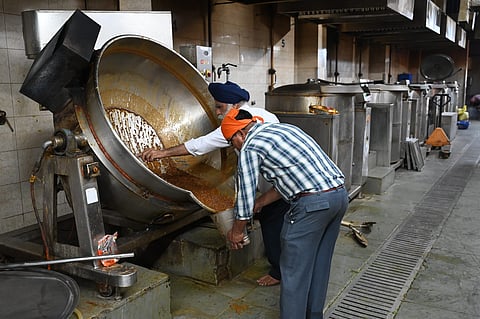
The daily food operations at Bangla Sahib Gurudwara in Central Delhi renowned for its langar that feeds hundreds of people everyday, had to pivot its operations after the energy crunch disrupted supply.
None leaves hungry
"People ask if the shortages will stop the langar, or if we will turn them away.We tell them the Guru's kitchen never closes and will keep running regardless of the circumstances," says Manjeet Singh, the head sewadar. When gas cylinders supply was temporarily halted during the initial weeks of March, we learned to adapt.
“We built wood-fired mud stoves in the open courtyard. Over the past week, we’ve arranged for PNG supply and have been using it.” Singh explains.“Now things are moving back to normalcy and no one leaves hungry,” Singh said.
Less on the plate
If community kitchens like the Langar adapted quickly, the logistical constraints were more evident at the Atal Canteen - a government scheme providing five rupees subsidized meals to daily wage workers - in Lajpat Nagar. Kitchens that were shut down last week reopened, but food shortage remains a problem.
Ganesh Rai, a cycle-rickshaw driver who is a regular at the canteen, wipes sweat from his brow in a line that snakes across the entire length of the canteen."The canteen used to give food without much waiting," Rai says."But now there is 30% less chapati; there was a complete closure last week. It’s improved this week and food is available, but it's still less and the queues have become longer."For men like Rai, an extra hour spent waiting in line translates directly into lost wages.
Meanwhile local eateries and dhabas have been the worst hit by the ongoing crisis. Eateries like the Shiv Dhaba, in Nehru nagar have had to switch to alternative fuels such as coal. It takes a lot of time to cook food using coal and is not a viable long term solution" says owner Anil Kumar.
While a commercial LPG cylinder used to cost around ₹ 930, Kumar has now switched to coal, which is slower and less efficient.
"Coal costs ₹40 per kg. We take 100 kg daily, which is around ₹4,000, costlier in the long run," he notes. The slower cooking times inevitably mean slower table turnover. "And there has been a sales decrease by 10 to 20 percent, but we have not raised prices as these customers depend on us for food.” For others, desperation has driven them into the shadow economy, bringing safety risks amid burgeoning costs. At Hungry Point Fast Food, owner Sudheer Sharma is grappling with soaring overheads amidst an entirely unpredictable supply chain.
Unpredictable times
"The supply of government cylinders has reduced, so we have had to buy them from the black market at times," Sharma says." Lack of cylinders forces us to buy expired cylinders, which cost around ¹2,000 to ¹2,500." While Sharma is aware of the safety hazards in using expired and untested cylinders, he has little choice but to rely on them amid the LPG crunch. He has also increased food prices by 15 percent unlike Shiv Dhaba.
While the global fuel crisis is currently testing Delhi’s ability to keep its kitchens running and the indomitable spirit of jugaad - which Delhi is famed for - keeps the embers burning for now, the rising costs, longer queues, and reliance on black market are testing both their limit and resolve.
