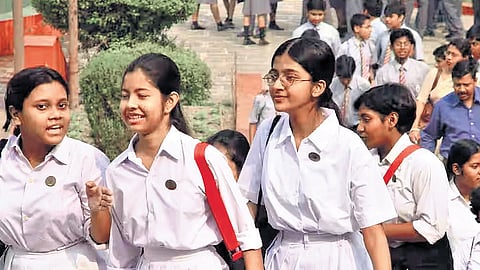

NEW DELHI: As the new academic session is set to begin, parents across Delhi-NCR are raising concerns over the rising cost of school books, alleging that many private schools are prescribing expensive sets dominated by private publishers. In several cases, even at the primary level, the number of privately published books far exceeds standard NCERT textbooks, significantly increasing the financial burden on families.
Parents have been pointing out that in classes as early as Grade 1, while there may be only three NCERT books, they are often accompanied by an equal or higher number of private publications. “Each of these private books costs between Rs 850 and Rs 1,250. When you add them, the total becomes unreasonable for such young children,” said a parent, Sana Hashmi, from East Delhi.
“We’re not against good quality material, but the pricing is excessive,” she added.
The issue extends beyond Delhi into neighbouring areas like Greater Noida. At Seth M R Jaipuria School, parents shared photos of the bill alleging that the prescribed Class 6 book set costs over Rs 4,000, despite including NCERT books worth only about Rs 260.
The bulk of cost, they claim, comes from eight private books priced at Rs 3,923. “What is the justification for such expensive private books when NCERT already covers the syllabus?” questioned a parent. “It feels like schools are prioritising profit over affordability.”
Adding to the concern is the alleged practice of restricting purchases to specific vendors. Parents claim they were directed to buy books and uniforms from a single authorised shop, eliminating the possibility of finding cheaper alternatives. “We were told very clearly that books and uniforms have to be bought from the designated store. Even basic items are priced much higher there,” shared a parent on X.
For many families, these costs come at a time when multiple expenses – admission fees, uniforms, transport, and annual charges – converge. “We ended up spending close to Rs 15,000 at the start of the session for a primary school child,” said another parent.
“For households with more than one child, this is a serious financial strain. Admission fees, uniforms, transportation for two kids and then the separate expenditure on the lunch menu set by the school. The calculations have gone out of budget,” said a parent buying uniforms outside the Ahlcon Public School.
Meanwhile, the education activists argue that such practices violate existing guidelines, which state that schools should not compel parents to purchase materials from specific vendors. “This is a clear case of commercialisation within education. There is a need for stricter monitoring and enforcement to ensure that parents are not exploited,” said an activist, Ashima, working on school regulation.
Despite repeated complaints, parents say action from authorities has been limited. “We have raised this issue before, but nothing has changed. Schools continue to operate the same way every year,” said a parent from Noida.
As frustration grows, parents are calling for transparency in pricing and a rationalisation of prescribed materials. “Education is essential, but it should not come with hidden costs and forced choices. There has to be accountability somewhere,” said Ramya Sain, resident of Mayur Vihar.
