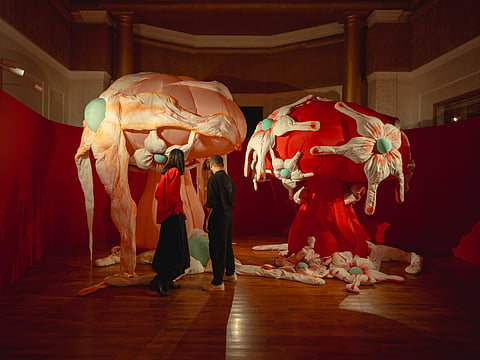

Mushroom-like structures, floating vines, and floral entities stretch across the canvas like octopus tentacles. Green human faces emerge from within them—smiling, dazed, contemplative—while polka-dotted seeds scatter across multicoloured canvas. This is the imaginative universe of Japanese artist Mari Ito, where the boundaries between the human, botanical, and psychological dissolve into something at once whimsical and faintly unsettling.
Presented by GEEK/ART, ‘Origin of Desire’—Ito’s first solo exhibition in India—is currently on view at Bikaner House till May 1. The show brings together sculptural works alongside large and small-format paintings, offering a glimpse into what has been described as Ito’s “biopolitical fabulism”—a practice that explores life, bodies, and desire through surreal, almost mythic imagery.

Born in Tokyo in 1980, and now based in Barcelona, Ito’s work is grounded in the meticulous traditions of Nihonga. Her process involves layering mineral pigments with sumi ink and nikawa (animal glue) on Oguni washi paper—a method that demands both precision and patience.
“I chose Nihonga because of the impression it left on me as a teenager,” she says. “I saw rows of pigment jars arranged in beautiful gradations of
colour, and I was captivated.” What keeps her committed to the medium is that unlike oil or acrylic, nikawa does not mask the pigment. “It allows the texture to remain visible—the matte, the sparkle. I find that raw beauty very appealing.”
Imagining desire
While her materials remain traditional, her imagery moves into more fluid, speculative territory. Ito constructs dreamlike landscapes where botanical life proliferates in excess, spilling across the frame in bursts of colour and form.
“I believe it all stems from imagining an invisible world,” she says. The exhibition’s title, ‘Origin of Desire’, reflects a long-standing preoccupation. “The roots of human desire are born unconsciously, even before we are aware of them. When I imagine how that takes shape, I paint those visions entirely from my imagination.” That imagination takes a botanical form.
In Japanese, the phrase hana ga aru—to “have a flower”—is used to describe someone with charisma or presence. Ito expands this idea beyond conventional beauty. “There are countless varieties of flowers. I wish for everyone to have their own ‘flower’ within them,” she explains.
In her works, these surreal blooms become embodiments of individual desire. Within them, human faces appear—sometimes joyful, sometimes ambiguous, occasionally unsettling. Ito looks at these expressions to map the diversity of desire itself. “Some roots of desire manifest as ‘good,’ others as ‘bad.’ I draw different faces to distinguish between these characters.”
In several works, a closer look reveals the artist herself woven into these whimsical landscapes—recognisable by her circular, wooden-framed glasses and double braids.
She appears quietly within the scene: in ‘Joy Can Last Forever, Depending on How You Perceive It’ (2025), she places herself in the four corners—perched on a petal, gazing upward with an animated expression. In ‘Origin of Desire: Happiness Begets Hippiness, and My Hope Multiplies’ (2024), she is seen grasping a seed while standing atop a flower, as if part of the form itself. In How Different Would My Future Be If I Wanted to Go Right and I Wanted to Go Left?’ (2025), she peeks from behind leafy structures, quietly observing the world she has created.
“Including myself acts as a kind of stamp—it shows that I, at this stage of my life, painted this work,” says the 46-year-old artist. She adds that it also reflects the nature of contemporary society, where “we all live within a world shaped by human desire. By placing myself among these representations, I’m expressing that I, too, am part of that collective human desire.”
Between cultures
Ito’s visual language is also shaped by her life between cultures. Having moved from Tokyo to Barcelona in 2006, she credits the Mediterranean environment with transforming her approach to colour. “The light in Spain is very intense, and colours appear more vivid,” she notes. “It made me start thinking about what ‘colour’ my own emotions might have.” In contrast to Japan’s more restrained modes of expression, this shift opened up new ways of visualising feeling itself.
While her work resonates with elements of Japanese surrealism and folkloric animism, Ito resists being confined to specific narratives. She cites artists across time and geography—from the fantastical worlds of Dutch painter Hieronymus Bosch to the intricate compositions of Japanese painter Ito Jakuchu. Despite working within a Western context, Ito has not felt constrained by expectations tied to her identity. “Being an Asian woman artist can sometimes bring more visibility today,” she reflects.
Her first visit to India has already begun to reshape her sensory world. “I was surprised by how much greenery there is in New Delhi. Even the sounds—the mix of birds, people, and traffic—felt alive.” She hopes to return. It will surely become a source of inspiration.”
In ‘Origin of Desire’, that openness is palpable. Ito’s works resist fixed meanings, instead inviting viewers into a space where desire is mutable, bodies are porous, and the boundaries between inner and outer worlds remain in constant flux. It is a universe that feels at once deeply personal and strangely collective—where, like her imagined flowers, each viewer might recognise a reflection of their own unseen desires.
On view at Bikaner House, Pandara Road, till May 1