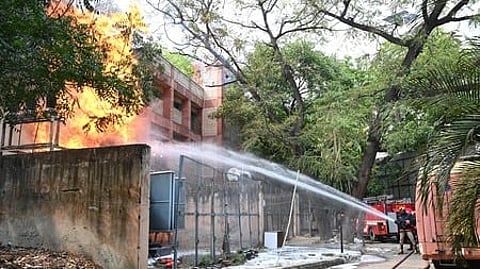

Last weekend, the capital witnessed a chilling reminder of how fragile urban safety can become when civic norms are ignored. A series of fire incidents across the Capital shook residents, the most tragic among them being the blaze in Vivek Vihar that claimed nine lives. Soon after, another fire broke out in Chawri Bazar, brought under control before it could turn catastrophic. These incidents exposed the dangerous intersection of illegal construction, public ignorance, administrative laxity and a growing culture of disregarding laws.
After visiting the Chawri Bazar site, Urban Development Minister Ashish Sood remarked that many residential buildings do not legally require fire department clearance and that residents themselves are responsible for ensuring fire safety. Technically, he may be correct. Yet governance cannot end with legal interpretation. The state has to create mass awareness regarding fire safety norms and ensure municipal regulations are understood as safeguards.
Reports after the Vivek Vihar tragedy suggest that the builder violated sanctioned plans by constructing additional apartments beyond the approved limit. More alarming is the fact that buyers willingly invested large sums in these “unsanctioned” properties. This reflects a disturbing mind-set of a willingness to bypass laws in pursuit of convenience, prestige or profit.
Municipal laws are the backbone of urban safety. Building norms related to ventilation, emergency exits, electrical load capacity, setback areas and fire access routes are framed after decades of learning from disasters. Violating them transforms homes into death traps. When extra floors are added illegally, electrical systems are overloaded and fire engines lose access to buildings. The consequences are often invisible until tragedy strikes.
Equally concerning is the changing nature of urban housing itself. In the race to market “luxury living”, builders increasingly prioritise aesthetics over safety. Homes today are filled with flammable decor, synthetic interiors, false ceilings and heavy electrical fittings.
In many apartments, balconies are covered entirely with iron grills in the name of security, effectively turning them into cages during emergencies. In the Vivek Vihar tragedy, residents found themselves trapped behind iron grills of their balconies, and the centrally controlled locking systems reportedly failed, once the short circuit disrupted electricity supply.
This points towards the absence of public understanding about basic fire survival measures. A city as densely populated as Delhi cannot rely solely on firefighters arriving after disaster strikes.
The first step towards that goal is awareness. Delhi requires a sustained city-wide fire safety campaign on the scale of public health drives. Resident Welfare Associations (RWAs), schools, colleges, market associations and housing societies should conduct periodic fire drills and awareness workshops. Citizens must know how to use fire extinguishers, identify overloaded electrical circuits, maintain emergency exits and evacuate buildings safely.
Secondly, municipal authorities must make compliance more transparent and accessible. There should be a publicly accessible digital system where residents can easily check building approvals, fire compliance status and occupancy certificates before buying property. Awareness campaigns should also emphasise that purchasing illegal property is a safety risk.
Thirdly, accountability must be strengthened. Periodic audits of residential buildings, especially in densely populated colonies, should become mandatory. Heavy penalties must be imposed on builders who compromise safety norms. Residents who knowingly violate regulations must also face penalties. Civic responsibility cannot remain a one-sided expectation.
Another crucial aspect is electrical safety. Public campaigns should educate residents about routine electrical inspections, certified wiring and safe appliance usage. Subsidised electrical safety audits in vulnerable neighbourhoods could save countless lives.
Delhi’s urban expansion has created a paradox. The city wants modern luxury but often neglects the fundamentals of safe living. A modern city is not one with taller buildings and expensive interiors, but one where human life is protected.
Sidharth Mishra
Author and president, Centre for Reforms, Development & Justice
