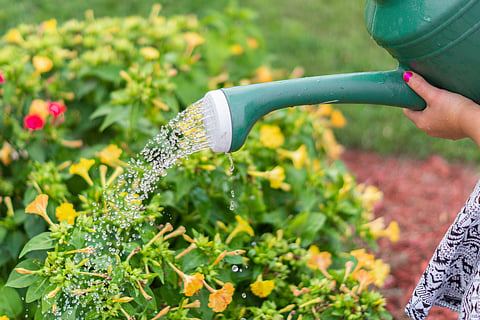

Watering plants appears to be one of the simplest tasks in gardening, yet it is also one of the most misunderstood. In urban landscapes across India—from balcony gardens in Mumbai to terrace gardens in Delhi, restaurant courtyards in Bengaluru, and coastal homes in Chennai—improper watering is among the most common reasons plants decline or die.
Plants need water to survive, but the key to healthy plant growth lies not in watering frequently, but in watering correctly. Understanding how plants use water, how soil holds it, and how climate affects evaporation can transform the way gardens perform.
Water plays several essential roles in plant life.
First, it helps transport nutrients from the soil to different parts of the plant. Minerals dissolved in water travel through tissues known as xylem, reaching stems, leaves, and flowers.
Second, water supports photosynthesis, the process through which plants convert sunlight into energy.
Third, water helps regulate plant temperature. During hot afternoons, plants release water vapor through tiny pores in their leaves, cooling themselves in a process known as transpiration.
Without adequate water, plants begin to show signs of stress—drooping leaves, dry edges, and stunted growth.
Surprisingly, plants often suffer more from too much water than from too little.
Roots require oxygen to survive. When soil remains constantly saturated, air pockets disappear, and roots begin to suffocate. This condition, commonly known as root rot, leads to yellow leaves, soft stems, and eventually plant death.
Plants adapted to dry environments are particularly sensitive to overwatering. Species such as Sansevieria (Snake Plant), Aloe vera, Agave americana, and Jade Plant (Crassula ovata) store water in their leaves and stems. These plants evolved in arid climates and require watering only when the soil has completely dried out.
These hardy plants perform well in indoor environments in cities such as Delhi or Mumbai, where apartment living often means limited watering access and irregular care routines.
While some plants prefer dry conditions, others thrive in consistently moist soil.
Tropical foliage plants such as Peace Lily (Spathiphyllum), Calathea, Maidenhair Fern (Adiantum), and Anthuriumoriginate from humid rainforest environments. Their roots expect steady moisture and higher humidity levels.
These plants perform particularly well in coastal and humid regions such as Chennai and Mumbai, where ambient humidity supports their growth.
However, even moisture-loving plants require good drainage. Soil that stays waterlogged for long periods can still damage their roots.
India’s diverse climates mean watering schedules must change depending on location and season.
In Delhi, summers are extremely hot and dry, with temperatures often exceeding 40°C. During these months, evaporation rates increase, and plants may require more frequent watering. Flowering plants such as Hibiscus (Hibiscus rosa-sinensis), Bougainvillea, and Tecoma stans (Yellow Bells) may need watering every two to three days in peak summer.
In Mumbai, the humid coastal climate changes watering needs. During the monsoon season, plants may receive sufficient natural rainfall, and watering frequency should be reduced to avoid root rot.
In Chennai, intense sun and high humidity create unique conditions. Plants require well-draining soil and steady watering schedules, particularly during the dry pre-monsoon summer months.
Timing also plays an important role in plant health.
Early morning is generally the best time to water plants. Watering during this time allows plants to absorb moisture before temperatures rise during the day.
Watering during hot afternoons is less effective because much of the water evaporates quickly. Evening watering can sometimes leave soil wet overnight, which may encourage fungal diseases in certain plants.
One of the most effective watering techniques is deep watering.
Instead of lightly sprinkling water on the soil surface, water should be applied thoroughly until it drains from the bottom of the pot or soil bed. This encourages roots to grow deeper into the soil, making plants more resilient during dry periods.
Trees such as Neem (Azadirachta indica), Jamun (Syzygium cumini), and Gulmohar (Delonix regia) benefit from deep watering during their early growth stages.
Once established, many native trees become surprisingly drought-tolerant.
Another important practice for maintaining soil moisture is mulching. Mulch refers to organic materials placed on top of the soil to reduce evaporation and regulate soil temperature.
Common mulching materials include dried leaves, coconut husk chips, wood bark, and straw.
Mulching is especially useful in hot urban environments like Delhi and Chennai, where soil can dry out quickly during summer.
Plants such as Ixora, Canna indica, and Heliconia benefit greatly from mulched soil because their roots prefer consistent moisture.
Perhaps the most important aspect of watering plants is observation. Instead of following rigid watering schedules, gardeners should observe how plants respond to their environment.
Drooping leaves, dry soil, or slow growth may indicate a need for water. Yellowing leaves or soggy soil may signal excessive watering.
By understanding the needs of each plant species and adapting to seasonal changes, watering becomes less of a routine task and more of a responsive practice.
Successful landscapes—from apartment gardens in Mumbai to terrace gardens in Delhi and coastal homes in Chennai—often depend on efficient watering practices.
When plants receive the right amount of water at the right time, they develop stronger roots, healthier foliage, and better resilience to environmental stress.
In many ways, watering plants is not simply a chore. It is an art—one that combines observation, timing, and an understanding of nature’s rhythms.
