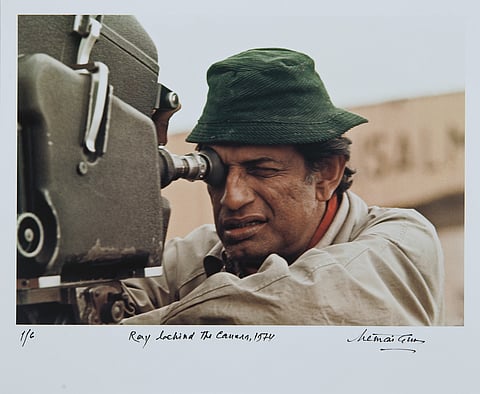

Few auteurs would allow another camera so close to their face while their own camera was on, but Satyajit Ray and Nemai Ghosh clearly had, as they say, ‘an understanding’. Ghosh’s camera trailed Ray not only when he was filming but also when he was thinking; when Ray was the subject of a documentary; when his actors, such as Smita Patil, shot him smoking his pipe with their cameras to keep a memento from Sadgati, her Ray film; and even when Ray was taking a walk on his balcony at home after his health took a hit in the 1990s. Ghosh had access, pure and simple.
A new exhibition based on his book, Faces and Facets: Satyajit Ray in Colour (on till July 4 at DAG, 22A Windsor Place, Janpath), gives an idea of how generous and unorthodox that access was. From the photographs, it seems there was no bridge he could not cross. Even when Ray sought solitude to rethink a shot in Ghare Baire (The Home and the World) away from his crew, Ghosh could follow him with his camera.
In the middle of a mustard field, while looking at his notes for Shatranj Ke Khilari (The Chess Players), Ghosh is close by. While Ray removes some red flowers next to some white ones in a vase so that they do not clash with the sari of Bimala (Swatilekha Chatterjee) in Ghare Baire, or acts out for Swatilekha the nature of anguish he wants from her before an almirah mirror—Ghosh’s camera is a breath away.

As Ray contemplates how to shoot an action scene with a camel caravan carrying his sleuth Felu (Soumitra Chatterjee), giving chase to a passing steam train in Sonar Kella (Golden Fortress) with a single camera, Ghosh takes his shot and hears Ray wisecrack that Kurosawa would have used nine cameras for the same action. What these colour photographs mounted by DAG reveal is not just Ray’s immersion in his work but also that he was happy to make space for Ghosh’s private project – Ray himself.
The cast and crew seem to have ribbed them both about it. Kamu Mukherjee, who played the bad guy in many Ray films, while killing time during a break in Joi Baba Felunath’s (The Elephant God) shooting, “stood right behind the photographer mimicking every action of his obsessive, unbridled pursuit of the Master”; Ray’s comical expression in response to his actor’s antics is a photo in the book because, yes, Ghosh clicked that too!
The work of documentation
Ghosh, who passed away in 2020, was a struggling theatre actor with an interest in photography. He met Ray on a lark, on the sets of his 1968 fantasy classic Goopy Gyne Bagha Byne, and shot two rolls of candid photos. At that time, Ray had already made his name, having directed cinematic classics such as The Apu Trilogy, Jalsaghar, (The Music Room), Charulata and Mahanagar (The Big City). Ray liked his compositions.
The director also perhaps saw in Ghosh a man ready to get wet, his surrender to a project that, over time, they came to share. Ghosh was almost the guardian of his archive—indeed, the world has seen Ray through his films and the photos Nemai Ghosh has taken of him. It has to be said, however, that many of the photos are truly bare-faced and simple, made interesting only by the fact that Ray is in them.
Ray even helped organise a showcase of Ghosh’s visual biography of his life and films at Cannes 1991, and personally signed off on the final selection of his favourite photos in Ghosh’s Ray books and other major exhibitions. In RSTV’s Guftagoo, Ghosh had called it “25 years of [Ray’s] indulgence”.
Ray was a meticulous man; documentation of his films was important to him. This aspect, too, has been captured by Ghosh with several photos of Ray referring to his red book, the thick kherorer khata used by accountants in Bengal. From his second film, Aporajito onwards, Ray always wrote a full script in this sturdy notebook. But on its margins is mayhem – it is full of doodles dles and scribbles of thoughts as if he couldn’t leave it to his memory, the exact shape of a brainwave.
Writer Jai Arjun Singh, who has authored The World of Hrishikesh Mukherjee and did the walkthrough of the DAG exhibition recently, remarked that, as much as he liked the idea of Ray being organised, he liked the idea that he could be random as well. In a country not well-known for maintaining cultural legacies, the work of Ghosh in preserving the world of Ray is an important contribution.
Part of the team
Ghosh’s association with Ray would last nearly half a century, encompassing 19 documentaries and feature films, some in black-and-white but mostly in colour. This includes Ghare Baire, Ashani Sanket, Shatranj ke Khilari and Sadgati. By this time, the still photographer was part of the ‘Ray team’—his association with Ray outlasted even that of Ray’s with his regular cameraman, Subrata Mitra. The Ray-Mitra partnership that had started with Pather Panchali (1951) ended with Nayak in 1966.
What is also striking about Ghosh’s photos is the kind of still photography he did. As Singh has written in his blog, “rarely did they resemble the conventional ideal of a promotional still – something that has a long tradition in mainstream cinema in the West, with attempts being made to encapsulate the basic idea of a scene in one image and actors striking representative poses for the cameraman’s benefit.”
Ghosh’s black-and-white photographs of Ray were also published in a book by DAG. The current exhibition, while it does bring out the warmth of Ray’s settings, the texture of his scenes, and the drama of shooting on location forcefully, in a way that colour can, it also forces the eye to look at Ray’s sunset. Unlike his black-and-white photographs, which made the audience look at the story’s emotional core, Ray’s classicism and his world seem shrunk by photographs in colour. But that could be just a subjective take.