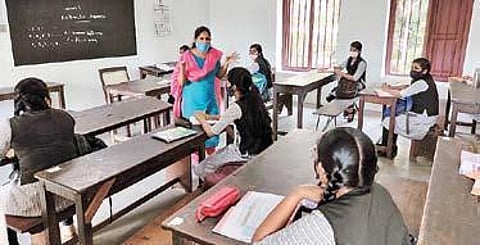

AHMEDABAD: Gujarat's government school system presents a striking contradiction in the latest official education data. While the number of government schools has remained broadly stable over the past five years, enrolment indicators for girls, Scheduled Castes (SCs), and Scheduled Tribes (STs) have declined sharply at the crucial Classes III-V Preparatory stage.
Data furnished by the Union Ministry of Education in the Lok Sabha on July 27, 2026, shows Gujarat had 34,699 government schools in 2021-22. The number fell to 34,597 in 2023-24 before rising to 34,734 in 2025-26.
Overall, the state ended the five years with 35 more government schools, representing a marginal increase of 0.10%, rather than a net decline.
The trend, however, has not been uniform. Gujarat lost 48 government schools between 2021-22 and 2022-23, followed by another 54 by 2023-24. It then added 41 schools in 2024-25 and another 96 in 2025-26. The latest figure is therefore 137 schools higher than the 2023-24 low.
The data does not separately identify how many schools were closed, merged, newly opened or reclassified. As a result, the increase in the total number of schools cannot, by itself, be interpreted as evidence that no closures occurred.
The more significant concern emerges from enrolment data.
While the overall school count has remained broadly stable, Gujarat's Gross Enrolment Ratio (GER) for girls has moved sharply in different directions across school stages.
At the Foundational stage, girls' GER increased from 36.7% in 2024-25 to 48.0% in 2025-26, a substantial rise of 11.3 percentage points.
However, the trend reverses sharply at the Preparatory stage, where the GER fell from 95.8% to 76.5%, a decline of 19.3 percentage points. Middle stage GER also slipped from 95.1% to 93.4%, while Secondary stage GER improved from 61.4% to 64.6%.
A similar pattern is evident among disadvantaged social groups.
Among SC students, GER rose by 9.8 percentage points at the Foundational stage, from 31.7% to 41.5%. However, the Preparatory stage ratio dropped from 87.0% to 67.8%, a decline of 19.2 percentage points. Middle stage GER fell from 86.5% to 83.1%, while Secondary stage GER increased from 59.3% to 62.1%.
Among ST students, Foundational stage GER increased from 34.6% to 44.6%. However, Preparatory stage GER fell even more sharply, from 96.6% to 78.0%, a decline of 18.6 percentage points.
Middle-stage GER declined from 100.5% to 98.5%, while Secondary-stage GER rose from 64.5% to 70.3%.
The most notable trend is that girls, SC and ST students all show a similar pattern: a strong increase at the Foundational stage followed by a steep decline at the Preparatory stage.
This makes the transition to Classes III-V the most significant pressure point emerging from the Gujarat data.
However, the figures do not establish that school closures or mergers caused the decline. The Ministry has supplied only GER, retention and school count data in response to the question.
It has not provided Gujarat specific evidence establishing a causal relationship between increased travel distance resulting from school mergers and enrolment outcomes.
The government has also stated that school opening, merger and closure fall within the jurisdiction of the respective states and Union Territories.
Gujarat's girls' retention data presents a contrasting picture.
Primary retention remained at 100% in both 2024-25 and 2025-26. Elementary retention was almost unchanged at 90.4% and 90.2%. Secondary retention improved from 69.3% to 70.6%, while Higher Secondary retention rose sharply from 44.8% to 56.2%, an increase of 11.4 percentage points in a year.
This presents another paradox. Gujarat has recorded stronger retention among girls at the Secondary and Higher Secondary levels even as Preparatory stage GER has fallen sharply.
The latest data therefore presents a more nuanced education picture than a simple narrative of government school closures.
Gujarat's government school network has remained broadly stable and is marginally larger than it was five years ago. However, the key concern lies within the system. The transition into Classes III-V has witnessed a sharp deterioration in GER among girls, SC students and ST students.
At the same time, girls' retention has improved significantly at the Higher Secondary level, suggesting that once girls remain within the education system, Gujarat is recording better persistence at the later stages.
The Union government has stated that the National Education Policy 2020 calls for school consolidation to be undertaken "very judiciously" and only when access is not affected.
It has also said that Samagra Shiksha supports school infrastructure, additional classrooms, transport, enrolment and retention drives, and other measures aimed at universalising school education.
For Gujarat, the key question is no longer simply how many government schools exist. It is why a relatively stable school network is accompanied by such a steep decline in Preparatory stage enrolment among girls, SC students and ST students, and whether the reasons lie in transition, population projections, migration, school access, reporting or other factors.
