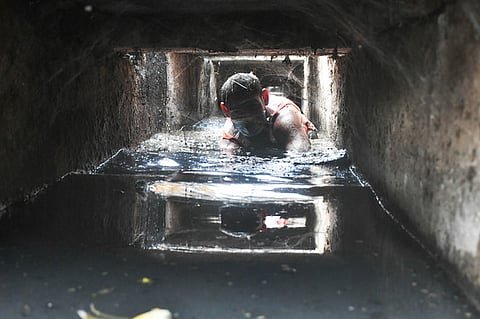

AHMEDABAD: Gujarat’s official record on manual scavenging has come under renewed scrutiny after the Union Ministry of Social Justice and Empowerment disclosed in Parliament that the state had identified just 105 manual scavengers in the 2018 survey, even as 7,648 sewer and septic tank workers have been validated under the NAMASTE scheme and 27 sanitation workers have died in hazardous cleaning operations since 2021.
The data, tabled in Lok Sabha on July 21 in response to two separate unstarred questions, reveals a troubling disconnect between official identification of manual scavengers and the continuing risks faced by sanitation workers in Gujarat.
According to Annexure-I of the parliamentary reply, Gujarat accounted for only 105 of the 44,217 manual scavengers identified nationwide in the 2018 survey a mere 0.24% of the national total. By contrast, Uttar Pradesh alone reported 20,884 manual scavengers, followed by Maharashtra with 6,325 and Uttarakhand with 4,854.
Yet Gujarat’s sanitation workforce under the NAMASTE scheme tells a very different story. The state has validated 7,648 sewer and septic tank workers, the fourth-highest figure in the country after Uttar Pradesh (12,463), Maharashtra (8,782), and West Bengal (7,630). This means Gujarat contributes 8.5% of India’s validated sanitation workers nearly 36 times higher than its share of identified manual scavengers.
The most striking contradiction lies in the gap between Gujarat’s official identification of manual scavengers and its validated sanitation workforce. While only 105 manual scavengers were identified in 2018, the state has since validated 7,648 sewer and septic tank workers under NAMASTE, indicating a vast workforce engaged in sanitation-related activities.
This raises critical questions: if no manual scavengers were found in the recent survey, as the Ministry stated, why do hazardous sewer and septic tank cleaning deaths continue to occur? And how effectively has mechanisation replaced manual intervention in Gujarat’s sanitation system?
The parliamentary reply also noted that “no report of the practice of manual scavenging has been received in the recent survey conducted in all districts.”
However, the same set of replies acknowledged that 332 sanitation workers across India lost their lives due to hazardous cleaning of sewers and septic tanks between January 2021 and June 2026.
Gujarat among the worst-hit states
Gujarat recorded 27 such deaths during this period, making it the fourth-highest state in India in terms of sanitation worker fatalities. Maharashtra topped the list with 58 deaths, followed by Haryana with 47 and Tamil Nadu with 38. Uttar Pradesh reported 37 deaths.
Gujarat’s 27 deaths account for 8.13% of all sanitation worker deaths in the country during the five-and-a-half-year period almost identical to its 8.5% share of validated sanitation workers. This suggests that the state’s fatality burden is disproportionately high compared to its officially identified manual scavenger count.
Safety measures fall short
Under the NAMASTE scheme, Gujarat has provided 7,345 PPE kits to its 7,648 validated sewer and septic tank workers, leaving 303 workers without protective equipment. Nationally, 2,878 of the 89,915 validated workers are yet to receive PPE kits.
The state has also been allotted 32 safety devices for Emergency Response Sanitation Units (ERSUs), representing 4.25% of the 753 devices distributed across India. Karnataka received 42 devices, Maharashtra 45, and Uttar Pradesh 91.
The Ministry listed the safety equipment provided under the scheme, including safety helmets with torches, safety tripods, axial fan blowers, anti-static conduits, full-body water suits, and multi-gas detectors.
The NAMASTE scheme, launched in 2023, has seen ₹203.66 crore released nationally, of which ₹175.83 crore has been spent. The Ministry clarified that the scheme does not have a state-wise allocation of funds.
The larger question
The data exposes a fundamental policy challenge: official surveys may declare districts free of manual scavenging, but sanitation workers continue to die while cleaning sewers and septic tanks. Gujarat’s figures 105 identified manual scavengers, 7,648 validated sanitation workers, and 27 deaths underline the need for a deeper investigation into how sanitation work is classified, monitored, and mechanised in the state.
For Gujarat, the numbers are not just statistics; they are a reminder that the battle against manual scavenging and hazardous sanitation work is far from over.
GUJARAT MANUAL SCAVENGING DATA
Manual scavengers identified (2018)-105
India total-44,217
Gujarat’s share of national total-0.24%
SSWs validated under NAMASTE-7,648
India total-89,915
Gujarat’s share of national SSWs-8.5%
PPE kits provided-7,345
India total-87,037
Workers without PPE kits-303
India total-2,878
ERSU safety devices-32
India total-753
Deaths (2021–June 2026)-27
India total-332
(Source: Union Ministry of Social Justice and Empowerment, Lok Sabha reply)
