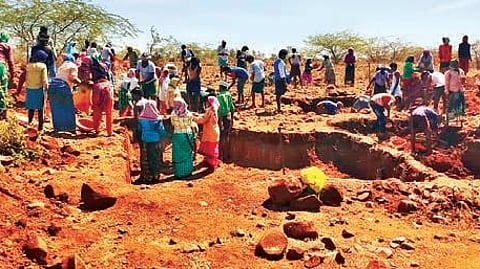

AHMEDABAD: Gujarat's rural employment landscape has witnessed a steady contraction over the last five years.
An analysis of three Rajya Sabha replies shows that the number of people seeking work under the Mahatma Gandhi National Rural Employment Guarantee Scheme (MGNREGS), persondays generated and Central funding have all declined sharply in Gujarat, even as the Centre has rolled out the new Viksit Bharat Guarantee for Rozgar and Ajeevika Mission (VB-G RAM G), promising 125 days of guaranteed employment from July 2026.
The data indicates weakening demand and reduced employment generation, while Gujarat begins the new scheme with one of the country's moderate allocations and comparatively low pending liabilities.
Even before the Centre expanded the rural employment guarantee from 100 days to 125 days under the newly launched VB-G RAM G, Gujarat's rural employment programme was already on a declining trajectory.
An analysis of three separate replies tabled in the Rajya Sabha on July 24 shows that Gujarat has recorded simultaneous declines in employment generation, the number of workers availing jobs and MGNREGS fund releases over the past five financial years, raising questions over the state's rural employment demand and implementation trends.
The sharpest decline is visible in employment generation.
Under MGNREGS, Gujarat generated 568.01 lakh persondays in 2021-22. This steadily declined to 465.98 lakh in 2022-23, marginally recovered to 492.72 lakh in 2023-24, but slipped again to 431.26 lakh in 2024-25 before falling further to just 312.70 lakh persondays in 2025-26.
This represents a decline of nearly 45% over five years, among the steepest contractions recorded by the state.
The decline is mirrored in worker participation. The number of people who availed employment under MGNREGS in Gujarat declined from 18.43 lakh workers in 2021-22 to 16.31 lakh in 2022-23, 15.12 lakh in 2023-24, 13.06 lakh in 2024-25 and finally 10.29 lakh in 2025-26, marking a decline of around 44% over five years.
Funding has followed a similar trend. Central releases to Gujarat under MGNREGS stood at Rs1,615.24 crore in 2021-22, increased to Rs1,694.60 crore in 2022-23 and further to Rs1,802.26 crore in 2023-24.
However, they declined to Rs 1,540.54 crore in 2024-25 and further to Rs 999.56 crore during 2025-26, marking the first time in five years that releases fell below Rs 1,000 crore.
Despite the declining trend, Gujarat enters the new employment regime with a sizeable allocation under the newly implemented VB-G RAM G, which came into force on July 1, 2026.
The Centre has earmarked an interim allocation of Rs1,540.54 crore for Gujarat, of which the first instalment sanctioned is Rs 310.64 crore.
Nationally, the Centre has made a record budget provision of Rs 95,692.31 crore, while the total programme outlay, including the state contribution, is expected to exceed Rs 1.51 lakh crore.
The Act also increases the statutory employment guarantee from 100 days to 125 days per rural household and allows the creation of livelihood linked assets such as skill development centres, digital learning centres and rural libraries.
As of July 19, 2026, Gujarat reported Rs 137 crore in pending MGNREGS liabilities, significantly lower than several large states, including Andhra Pradesh (Rs 3,278.09 crore), Bihar (Rs 2,171.48 crore), Uttar Pradesh (Rs 1,823.66 crore), Maharashtra (Rs1,754.60 crore) and Rajasthan (Rs 1,654.60 crore). Nationwide pending liabilities stood at Rs 19,310.07 crore.
In its reply, the Rural Development Ministry maintained that all admissible pending wage liabilities up to FY 2025-26 had been cleared and that wage payments are being made through Direct Benefit Transfer and the National Electronic Fund Management System.
The Ministry said, "States have been asked to submit proposals for any pending liabilities so that eligible payments can be released expeditiously."
The combined data paints a mixed picture for Gujarat. While the state enters the new 125-day rural employment guarantee programme with relatively low outstanding liabilities, the long-term trend shows fewer rural workers seeking employment, fewer persondays being generated and lower Central fund releases under MGNREGS.
The rollout of VB-G RAM G will now test whether the expanded guarantee and higher national funding can reverse this sustained decline in Gujarat's rural employment indicators.
