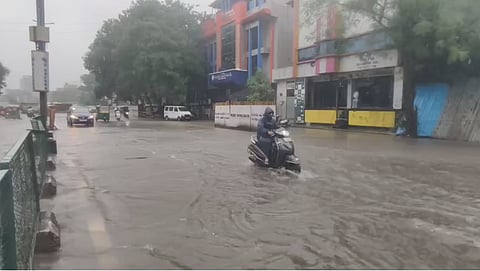

AHMEDABAD: Gujarat's monsoon intensified on Friday as torrential rain lashed Surat and large parts of South Gujarat, flooding low lying areas, disrupting traffic and prompting the administration to step up emergency measures after the India Meteorological Department (IMD) issued a red alert for 13 districts.
Heavy rain battered Surat from the morning of July 31, rapidly turning several parts of the city into waterlogged zones. Areas including VIP Road, Pandesara, Katargam and Dabholi were inundated, while the overflowing Bhedawad creek heightened the flood threat.
The situation was particularly serious as Surat and several neighbouring districts had already been affected by repeated spells of heavy rain.
The latest weather system has triggered a fresh round of precautionary measures across the region, with authorities advising residents to avoid unnecessary travel.
The IMD has issued a red alert for 13 districts Ahmedabad, Vadodara, Anand, Narmada, Chhota Udepur, Bhavnagar, Botad, Bharuch, Valsad, Surat, Tapi, Dang and Navsari, warning of extremely heavy rainfall, thunderstorms, lightning and squally winds.
The impact was not confined to Surat. Intense rainfall disrupted road traffic and normal life across several parts of Central and South Gujarat. On Friday, Umarpada in Surat recorded nearly eight inches of rain, while Borsad in Anand received more than six inches by noon, highlighting the intensity of the downpour.
With rivers and drainage systems under pressure, the state has shifted into a heightened disaster response mode. Seventeen National Disaster Response Force (NDRF) teams, 33 State Disaster Response Force (SDRF) platoons and six Army columns have been deployed, while more than 720 people have already been evacuated from vulnerable low lying areas in Vadodara, Surat, Anand and Narmada districts. Twenty one dams have also been placed on high alert as water levels continue to rise.
In Surat, the worsening conditions prompted the district administration to order the closure of all factories for two days to reduce movement and minimise risks to workers during the peak of the weather event.
The administration has also declared a holiday for all schools, colleges and anganwadis on August 1, with educational institutions remaining closed as the IMD forecasts another spell of heavy rain.
An Army team was sent from Vadodara to Surat to strengthen relief and rescue operations, adding military personnel to the existing disaster response machinery.
The administration has also cancelled the leave of all officers and employees with immediate effect to ensure that the government machinery remains fully operational during the crisis.
Health Minister Praful Panseria visited the Disaster Management Office and held a review meeting with senior officials, including the district Collector, to assess the evolving situation and coordinate the response.
Officials said the immediate priority was prevention, evacuation and rapid response rather than waiting for flooding to worsen.
People have been advised to remain indoors or move to safer locations and avoid unnecessary travel, particularly as heavy rain is expected to continue through the day and into the night.
The warning is especially significant for people living in low lying areas, near overflowing water bodies and along vulnerable roads, where even a short spell of heavy rain could quickly disrupt connectivity.
The latest spell follows an already damaging phase of the monsoon across Gujarat. Between July 23 and 27, widespread flooding and waterlogging forced the closure of 1,540 roads across the state, with South Gujarat accounting for 1,251 closures, the highest among all regions. Of these, 1,236 have been reopened, while traffic was restored on 1,187 roads within 24 to 48 hours.
That fragile recovery now faces another test.
Surat, Valsad, Navsari, Bharuch, Tapi and Dang remain among the key districts under close watch as the weather system moves westwards towards Gujarat.
The IMD has warned of another spell of heavy to very heavy rainfall between July 31 and August 1, with isolated places likely to receive extremely to exceptionally heavy rain.
The latest system is being driven by a deep depression over west central Chhattisgarh and adjoining Vidarbha and southeast Madhya Pradesh, which is expected to move westwards towards Gujarat while gradually weakening.
An active monsoon trough and an east-west shear zone across central India are also supporting widespread rainfall activity.
For Surat, however, the immediate concern is the sheer volume of water already accumulating across the city and district.
With creeks overflowing, low lying areas submerged and more rain forecast, authorities are racing against the next spell rather than waiting for the current flooding to recede.
The administration's precautionary shutdowns, deployment of rescue teams and cancellation of staff leave reflect the seriousness of the warning.
Gujarat is not facing an isolated spell of heavy rain, but another widespread monsoon challenge, with South Gujarat once again at the centre of the storm.
