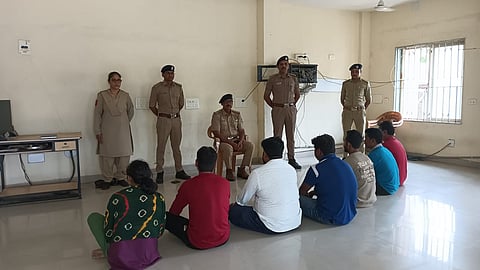

AHMEDABAD: A statewide crackdown on illegal immigration in Gujarat has led to the identification of 166 Bangladeshi nationals in Ahmedabad alone, while parallel operations in Surat, Rajkot and Vadodara have exposed an alleged network of unauthorised settlements, identity manipulation and cross border financial transactions.
What began as a coordinated search operation on June 2 has evolved into one of the largest crackdowns on illegal foreign nationals witnessed in the state in recent years.
At the centre of the operation was Ahmedabad, where joint teams from the Crime Branch, Special Operations Group (SOG) and local police conducted raids, detentions, interrogations and verification drives across multiple localities throughout the day and late into the night.
Police detained nearly 300 suspects during the operation. Following intensive scrutiny of documents and identities, 166 individuals were confirmed to be Bangladeshi nationals.
The group comprised 41 men, 95 women and 30 children. Investigators are continuing to verify the identities of several others who remain under questioning.
The crackdown focused heavily on Chandola, Gulabnagar and Khodiyarnagar in Danilimda, areas that have remained under the scanner following previous operations.
Officials believe earlier police action in Chandola forced many illegal immigrants to disperse to different parts of Ahmedabad, where they assumed new identities and moved into rented houses, slums, labour colonies, hotels and commercial establishments to evade detection.
As the operation gathered momentum, Ahmedabad Police Commissioner G.S. Malik personally visited the Crime Branch headquarters to review the investigation.
He questioned detainees about their arrival in India, the routes used to cross the border, the duration of their stay and their places of residence. He also interacted with officers leading the operation and commended the teams for carrying out the large scale drive.
Explaining the findings, Police Commissioner G.S. Malik said, "The operation was conducted under the supervision of Ahmedabad Crime Branch Joint Commissioner Sharad Singhal. Around 300 suspects were detained, out of which 166 have been confirmed as Bangladeshi nationals. These include 41 men, 95 women and 30 children. Some entered India only a few months ago, while others have been living here for several years. We are investigating the agents who facilitated their entry. Preliminary findings show that several women were engaged in spa related and prostitution activities, while many men were working as daily wage labourers."
The investigation has also revealed a financial trail extending beyond Gujarat. During questioning, several detainees told investigators that money earned in Ahmedabad was routinely transferred to Kolkata through the angadia network before being routed to Bangladesh.
Investigators have also found that certain mobile applications were being used to transfer funds across the border, prompting a deeper probe into possible hawala style channels and digital money transfer routes.
Police sources said the financial aspect of the case is receiving special attention as authorities seek to identify individuals and networks facilitating these transactions.
Investigators are also attempting to trace agents who arranged border crossings and helped immigrants settle in various cities using forged or manipulated identities.
The crackdown was not limited to Ahmedabad. In Surat, police launched an extensive verification drive that led to the identification of more than 100 suspected Bangladeshi nationals.
Following document verification and background checks, authorities confirmed that more than 50 individuals were Bangladeshi nationals.
Surat Police have completed the identification process and initiated legal proceedings against those found to be staying illegally.
Officials said further action is under way to complete deportation formalities and facilitate their return to Bangladesh in accordance with legal procedures.
Meanwhile, Rajkot Police launched a parallel operation at 1 a.m., deploying 10 dedicated teams across the city.
Acting on information received from the Home Department, officers questioned 272 individuals believed to be of Bangladeshi origin.
Preliminary findings in Rajkot indicated that many of those questioned were legally residing and working in the city with valid work permits.
However, scrutiny continues for individuals who failed to produce Aadhaar cards or other identity documents.
Police said strict legal action would be taken against anyone found without valid visas or mandatory immigration documents.
In Vadodara, police carried out a late night search operation targeting suspected illegal Bangladeshi immigrants across multiple parts of the city. Teams conducted intensive verification drives in areas including Sayajiganj, Fatehpura and Navayard, where officers checked identities, documents and residential records.
During the operation, nearly 150 people were verified by police teams. Following scrutiny of documents and background checks, seven Bangladeshi nationals, including one woman, were detained for further investigation.
Sharing details of the operation, the Vadodara City Police Commissioner said the verification drive formed part of the statewide crackdown aimed at identifying foreign nationals residing illegally in Gujarat.
With simultaneous operations under way in Ahmedabad, Surat, Vadodara and Rajkot, Gujarat Police have signalled a broader statewide strategy.
Officials believe illegal immigrants are increasingly avoiding concentrated settlements and are instead blending into different neighbourhoods under altered identities.
As a result, law enforcement agencies have expanded their focus beyond traditional hotspots and are now conducting citywide and state level verification drives.
The ongoing investigation is expected to reveal not only illegal immigration routes but also the networks that provide shelter, employment, forged identities and financial channels to those entering and residing in the country unlawfully.
For Gujarat Police, the operation has evolved from a routine verification exercise into a far reaching probe into an organised ecosystem operating beneath the radar.
