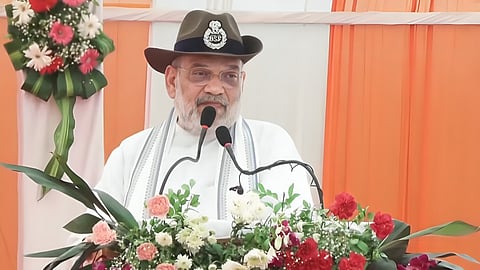

AHMEDABAD: Union Home Minister Amit Shah on Friday reviewed security arrangements along India’s western frontier during a visit to the highly sensitive Harami Nala and Sir Creek region in Gujarat’s Kutch district.
During the visit, Shah assessed border preparedness, inspected advanced security infrastructure, and interacted with Border Security Force personnel deployed in one of the country’s most challenging border terrains.
The visit began with Shah inspecting operational arrangements along the international border before inaugurating the newly-built Border Outpost G-7. He later interacted with BSF jawans stationed in the hostile marshlands of Harami Nala an area long considered vulnerable because of its difficult geography, tidal channels and infiltration risks.
Shah later visited the control room at OP Tower 1170 and undertook a boat patrol in the Sir Creek region, getting a first-hand view of the operational challenges faced by security forces in the area’s muddy and shifting terrain.
A tree plantation programme was also organised at the jetty point during the visit.
The high-profile tour concluded with a closed-door review meeting at the BSF Sector Headquarters in Bhuj, where Shah discussed border-related challenges and long-term security planning with senior officials.
The visit marked Shah’s second trip to Kutch in six months after he attended the BSF Raising Day celebrations in Bhuj last November.
Addressing BSF personnel, Shah said that every visit to frontline posts reminds him of the sacrifices made by soldiers guarding the borders under extreme conditions.
“Whenever I am in the midst of BSF personnel, my fatigue instantly disappears,” Shah said.
“When we reach your posts and see the conditions in which you live, we realise how difficult your duty is. You stand here protecting the borders of India with a smile on your face, and that makes us feel our work in Delhi is far easier. If you are not tired while defending the nation, then we have no right to feel tired either,” he said.
Shah said the BSF has spent six decades protecting two of the world’s most difficult borders, Pakistan and Bangladesh, while battling extreme weather, hostile terrain and constant operational pressure.
“From minus 45 degrees in the snow-covered mountains to plus 45 degrees in the deserts, BSF jawans have protected the nation under unimaginable conditions,” he said.
“Whether it is the muddy land of Sir Creek and Harami Nala, the scorching desert of Rajasthan, or the forests and mountains of the Northeast, the BSF has stood as India’s first line of defence since 1966.”
Recalling his recent visit to border posts in extreme heat conditions, Shah said the commitment of the force goes beyond ordinary service.
“I recently visited Sanchu, where the temperature was touching 46 degrees, and at another fort it crossed 50 degrees,” he said.
“Yet our jawans continue their duty without hesitation. From the snowy hills of Kashmir to the forests of Meghalaya and Assam, BSF personnel have protected India’s borders for six decades. and nearly 2,000 jawans have sacrificed their lives in the line of duty.”
The Home Minister said the courage of the BSF has earned the trust of 140 crore Indians and ensured peaceful sleep for citizens across the country.
“Because of your bravery and devotion, the people of India sleep peacefully with faith in the nation’s security,” Shah said. “Not only the Government of India but the entire country respects the BSF.”
Highlighting efforts to connect civilians with the realities of border security, Shah referred to a newly built awareness centre in Banaskantha developed at a cost of around Rs 250 crore.
“This centre is helping lakhs of people understand the difficult life and duty of BSF jawans,” he said.
“Around 2.5 lakh people visit or receive information every month. During feedback surveys, many mothers wrote that they would feel proud if their children joined the BSF. That emotional respect from ordinary citizens is your biggest achievement.”
Shah then shifted focus to the government’s border modernisation push and revealed that Harami Nala and Sir Creek had once been identified as weak points in India’s security grid.
“When I became Home Minister, one of the first BSF reviews highlighted that Harami Nala and Sir Creek were lagging in terms of security infrastructure,” he said.
“We prepared a comprehensive leak-proof security plan, including watch towers, roads, drinking water facilities, medical infrastructure, accommodation and modern fencing. Today, 70 per cent of that work has been completed, and the Home Ministry is satisfied that this region has become secure against enemy activities within just two years.”
The Home Minister acknowledged the harsh realities faced by troops but promised continued support from the Centre.
“We cannot remove the harsh climate because it is part of your duty,” Shah said.
“But we can reduce your hardships by improving facilities. Prime Minister Narendra Modi and the Home Ministry are fully committed to ensuring that BSF personnel receive every possible support. We have never allowed budget limitations to come in the way.”
Praising the engineering efforts undertaken in the marshy terrain, Shah said constructing infrastructure in the region was itself a battle.
“When I came here today, I understood how difficult it is to build towers in this type of land,” he said.
“Our teams found technical solutions and successfully constructed watch towers. Entire border outpost areas were raised four-and-a-half metres above ground level while stone walls were built to stop floodwaters from damaging roads.”
He recalled personally monitoring the survey work during the project phase.
“I remember following up daily to ensure survey work was never delayed,” Shah said.
“Today, as I stand here with Sir Creek in front of me and BSF jawans sitting before me, I can confidently say that you are standing like a wall between the enemy and the people of Bhuj.”
In a significant remark, Shah also hinted at a possible expansion of the BSF’s operational jurisdiction in the future.
“It is the 60th year of the BSF,” he said. “No final decision has been taken yet, so it would not be appropriate to say more at this stage. But we are considering expanding into new areas.”
Turning to eastern border security, Shah described incomplete fencing in West Bengal as one of the biggest flaws in India’s border defence network.
“We cannot change geography, but wherever fencing is possible, it must be completed,” he said. “For years, land-related issues delayed fencing work in Bengal. But after the BJP government came to power there, the Chief Minister has taken a principled decision to provide all required land within a week.”
He said once fencing is completed, infiltration routes would shrink dramatically.
“After fencing is completed, infiltration can only happen through forests and rivers,” Shah said. “For that too, technical fencing systems are now being introduced. In the coming years, because of the courage and commitment of BSF jawans, India’s borders will become completely secure.”
Shah concluded his address by praising the transformation of Gujarat’s border security landscape, saying areas once notorious for smuggling and illegal activities are now firmly under control.
“There was a time when smuggling, including explosives used in bomb blasts, used to take place through Gujarat’s border,” he said. “Today, Gujarat’s border has become secure. Because of your dedication, the people of Gujarat feel safe.”
