
AHMEDABAD: Once the faces of the 2015 Patidar reservation agitation against the BJP government, Hardik Patel and Alpesh Kathiriya are now part of the ruling party's political landscape.
Yet, their latest cryptic social media posts about silence, self-respect and strength have brought their political journey back into focus, amid renewed debate over Patidar leadership, representation and the community's political identity ahead of the 2027 Gujarat Assembly elections.
Nearly a decade after they emerged as prominent faces of the Patidar reservation agitation that shook Gujarat's political establishment, Hardik Patel and Alpesh Kathiriya are once again drawing attention together.
However, the latest spotlight on the two former agitation partners comes not from a protest or political platform but from a pair of cryptic social media posts that have triggered fresh discussion about their political journey, standing and the changing dynamics of Patidar politics.
The contrast is striking. Leaders who once challenged the BJP government on the streets over reservations are now associated with the ruling party. Yet, their latest messages, centred on silence, self-respect and the ability to make history, have brought their past association and present political positions back into public discussion.
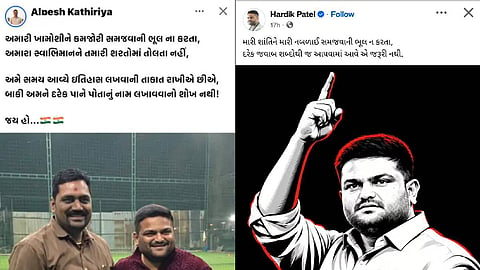
The sequence began on the evening of November 25, when Viramgam BJP MLA Hardik Patel shared a photograph on his social media account, accompanied by a song featuring Tamil superstar and politician Vijay Thalapathy. However, it was the caption that attracted attention.
"Do not make the mistake of mistaking my silence for weakness; it is not necessary for every response to be given through words," Hardik wrote, without specifying whom or what he was referring to.
Soon afterwards, Alpesh Kathiriya, Hardik's former associate from the Patidar Anamat Andolan Samiti (PAAS) and a prominent face of the 2015 agitation, shared an old photograph of the two together. His caption appeared to echo Hardik's message, although neither identified the intended target.
"Do not make the mistake of mistaking our silence for weakness. Do not attempt to measure our self-respect by your own standards. We have the strength to write history when the time comes; it is simply that we do not wish to see our names written on every page," Kathiriya wrote.
The striking similarity in their messages has fuelled speculation, but the posts do not establish whether they are connected to a common issue, a political development or a personal sentiment. Nevertheless, their timing has drawn attention because both leaders have travelled a long political distance since the agitation that made them prominent in Gujarat.
Hardik, who emerged as one of the most recognisable faces of the 2015 movement, joined the BJP and subsequently won the Viramgam Assembly constituency in 2022. Kathiriya, meanwhile, also moved into the BJP's political orbit after his association with the agitation.
Their political journeys reflect the transition of several prominent faces of the reservation movement from confrontation with the ruling establishment to participation in mainstream party politics.
However, the legacy of the agitation continues to influence discussions within the Patidar community, particularly over political representation, leadership and the movement's consequences. With the 2027 Assembly elections approaching, these questions are gradually returning to the political centre stage.
A recent community gathering in Jasdan, Rajkot, brought this unresolved political legacy into focus. At a grand 'Sakhi Snehmilan' organised at the Patidar Shaikshanik Bhavan, Patidar leader Dinesh Bambhania publicly expressed regret over Anandiben Patel losing the Chief Minister's post in the aftermath of the 2015 agitation.
The remarks reopened debate over the political cost of the movement and its impact on the state's leadership. Hardik, however, rejected the claim that the Patidar agitation was responsible for Anandiben Patel's resignation. While disagreeing with Bambhania's interpretation of events, he maintained that he had no regrets about the agitation itself.
The contrasting positions underline how the 2015 movement continues to be interpreted differently by Patidar leaders, even as its prominent faces have entered different phases of mainstream politics.
Meanwhile, the debate is expanding beyond the Patidar community. Praful Patel, Administrator of Daman and Diu, recently called for unity between the Patidar and Anjana Chaudhary communities while addressing the Pran Pratishtha ceremony of Goddess Arbuda in Sabarkantha. His appeal has added a new dimension to the discussion over caste consolidation and wider social alliances ahead of the 2027 elections.
The emerging political conversation is therefore no longer limited to reservation demands or the legacy of agitation. Community leaders are increasingly raising questions about political representation, leadership opportunities and the need for broader social alliances.
These developments indicate that caste equations and community-based mobilisation will remain important themes in Gujarat's electoral discourse.
Against this backdrop, Hardik and Kathiriya's posts have acquired significance beyond their social media reach. Their journey from leading a movement against the BJP government to becoming part of the ruling party presents a striking contrast, while their latest messages have once again placed their political identities in the spotlight.
Whether the posts carry a larger political message or are simply expressions of personal sentiment remains unclear. What is evident, however, is that as Gujarat moves towards the 2027 Assembly elections, the questions raised by the Patidar agitation about leadership, political recognition and community representation have not entirely disappeared. Nearly ten years later, they continue to shape the conversation around Patidar politics.
