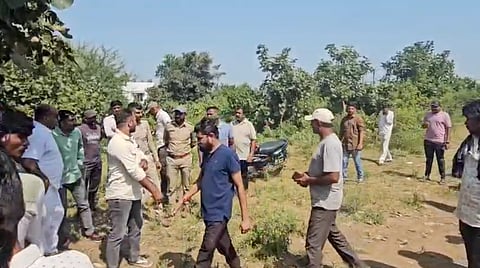

AHMEDABAD: A lioness mauled a 30-year-old man to death after attacking him while he was sleeping outside his home in Gujarat’s Gir Somnath district, sparking fear in a village bordering the Gir forest.
The incident in Valadar village has also triggered a compensation dispute, with the victim’s family refusing to accept his body, claiming that the Forest Department’s Rs 10 lakh assistance is insufficient to secure the future of his five children.
The incident has once again brought the growing human-lion conflict in Gujarat’s Saurashtra region into sharp focus, where big cats frequently venture into villages and agricultural fields.
The victim, Mahesh Pratap Rathod, was sleeping outside his house on a table late at night when the lioness attacked him and dragged him away. After his family returned home and found him missing, relatives and villagers launched a search. His body was eventually recovered around 1.5 to 2 km from his residence.
The incident plunged the family into grief and spread panic across Valadar and neighbouring areas. The body was shifted to a government hospital for a post-mortem examination, even as the family demanded higher compensation, saying the existing assistance would not ensure the future of the five children left behind by the deceased.
The incident has renewed concerns over the risks faced by residents of villages along the Gir forest landscape, where orchards and agricultural holdings bring people into close proximity with Asiatic lions.
Hanif Makrani, former sarpanch of Valadar Gram Panchayat, said repeated appeals to officials had failed to ease residents’ concerns over the presence of lions near human settlements.
“People lose their parents or their sons to lion attacks. We repeatedly inform the officials, but the problem continues. Our village lies on the edge of the Gir forest, and nearly 90 per cent of the land is used for horticulture. In fact, more lions are found in the orchards than in the forest itself,” he said.
Calling for government intervention, Makrani urged Gujarat minister Arjun Modhwadia to raise the issue with the state government and seek higher compensation for families that lose their breadwinners to lion attacks.
“When a lion kills the earning member of a family, the children are left in distress. The government should consider compensation of around ₹40 lakh so that these families can sustain themselves and secure their children's future,” he said.
Mahesh’s brother, Mukesh Rathod, said the family had been away when the attack took place and realised something was wrong only after returning home.
“Mahesh had gone to Porbandar for manual labour about two months ago. After our grandfather, who lived in Jamvala, passed away, he went there to offer condolences and later returned to Valadar. He was alone at home when the incident occurred,” Mukesh said.
He added that the family had gone to Jamvala in the morning and returned at night, only to discover that Mahesh was missing.
“We informed our relatives and searched for him, but initially there was no trace. Two or three of us then went out at night to look for him. When we discovered what had happened, we immediately informed the villagers and the Forest Department. A lioness was spotted in the area, but it has not yet been captured,” he said.
Valadar sarpanch Jitu Solanki said the lioness had attacked Mahesh while he was sleeping outside his home.
“Three cages have been installed in the village, but the lioness has not yet been caught. The family has told me that it will not accept the body until adequate compensation is provided,” Solanki said.
Following the fatal attack, the Forest Department installed three cages in the area and began measures to track the lioness and prevent further incidents.
However, the animal remained at large at the time of the report, keeping residents on edge.
The incident adds to a series of concerns over human-wildlife encounters in Saurashtra, where lion habitats overlap with villages, farms and horticultural plantations. The presence of lions outside protected forest areas poses risks to residents, particularly those sleeping outdoors or working in fields after dark.
In a separate incident highlighting the risks associated with lion encounters in Gujarat, a two-to-three-year-old lioness died at an animal care centre in Amreli district on October 3, around 20 hours after being rescued from Arjunsukh village.
The lioness had been rescued on October 2 after allegedly attacking five people, including four villagers and a Forest Department official, in separate incidents. It was subsequently shifted to the Krankach Animal Care Centre, where officials observed unusual behaviour, including biting and strange vocalisations.
A senior Forest Department official said the animal was suspected to have died of rabies, although confirmation was awaited. Samples of its brain tissue were sent to Anand Agricultural University for examination.
While the Amreli case involved suspected disease and the Valadar incident a fatal attack on a sleeping villager, both have underscored the challenges confronting wildlife authorities in managing encounters between lions and people across Gujarat’s Saurashtra region.
For Valadar’s grieving family, however, the immediate concern remains the future of five children and the demand for compensation they believe will provide meaningful financial security after the loss of their breadwinner.
