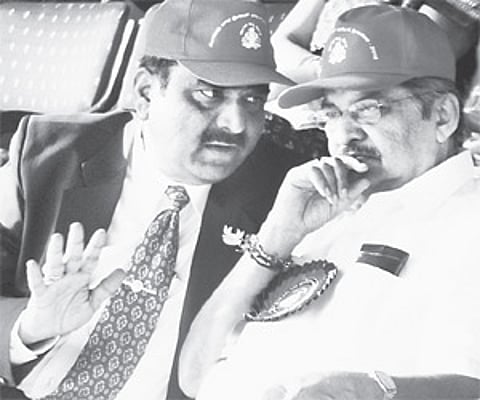

BANGALORE: Home Minister V S Acharya has been under the scanner of the Opposition and the media for his “alleged failure,” to protect law and order. The Opposition has even doubted his handling of sensitive cases including the infamous Padmapriya death, the communal violence and the latest pub attacks in Mangalore. However, Acharya seems unperturbed.
On Sunday, the Home Minister stated that the government would set up a media ombudsman to curb “sensationalising reports,” both in electronic and print media.On Monday, however, he said that he was only reflecting views of several people at a peace meeting in Mangalore. “I have been receiving calls from Bidar to Chamarajanagar and from Kolar to Malpe, to restrict the media,” he said. When quizzed by the media, he elaborated his views and defended the decision.
Q: Would you clarify your statement on media ombudsman? Acharya: This is not my view. It is a reflection of views expressed by a cross section of people attending a peace meeting in Mangalore. Several of them wanted a ban on media, particularly electronic media after the pub attack and the recent kidnap case.
I was only summing up their views and trying to convince those arguing for a ban that it was not fair to curb freedom of press. We are followers of Deendayal Upadhyaya and never believed in curbing media. I was only assuaging the people’s feelings.
Q: There already exists a Press Council of India (PCI), what is the need for a parallel body? Acharya: Where is PCI? Is it functioning and performing any duties? Q: What will be the role of the proposed ombudsman? Acharya: We believe in freedom of press and media. There is no question of curbing any freedom. What we want is that media should be responsible while reporting on any issue.
Reports on January 24 (pub attack), February 6 (kidnap of Kerala MLA’s daughter) and the pulse polio had created panic among public. Several people are of the view that Padmapriya committed suicide because of premature reporting. Media first gives judgment and then verifies facts. To stop such premature reporting, we are considering the creation of an ombudsman.
Q: When is the government planning to create the new body? Acharya: It is still under consideration.
I will discuss with all concerned people, including the Chief Minister. We will explore all options and seek opinion of experts to create the ombudsman, probably headed by a judge.
Q: In the past 50 years, there was no need for creating such a media watchdog. What made you to decide on setting up of an ombudsman in just eight months? Acharya: It is not just in the last eight months. There has been an accumulation of several incidents (of wrong reporting and sensationalisation by media). Now the time has come to create an ombudsman.
Q: Are you satisfied with your performance? Acharya: Yes. The crime detection rate has gone up, after I assumed charge. I have been interacting with senior officials and specialists on modernising police force. I am now focusing to ensure that detected cases are taken to the logical end by punishing the culprits.
