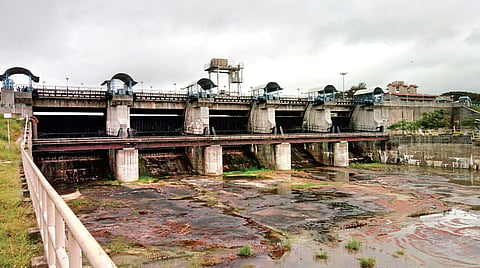

TUMAKURU: A poor monsoon resulting in poor storage in the Hemavathi reservoir in the Cauvery basin has lakhs of farmers worried. In fact, the situation is so dire that many farmers have taken to daily-wage labour to earn a living.
The Hemavathi dam, which has a total storage capacity of 37 tmcft, has only 7 tmcft water at present. According to officials, only 3 tmcft of water can be used as the rest is dead storage, meaning it cannot be drawn.
Officials added that since June, as much as 16 tmcft of water has been let out from the Hemavathi into the Krishna Raja Sagar dam, from where the Cauvery further meanders into Tamil Nadu. Usually, one third of water from Hemavathi is let out to KRS, officials said.
Interacting with mediapersons who are on a tour of the Cauvery basin reservoirs and command areas, the officials said that Tumakuru district has 176 tanks of which 21 have 50 to 100 per cent water. The water has been let into the lakes for drinking water purpose. The rest of the tanks have gone completely dry, K Balakrishna, Chief Engineer, Hemavathi (canals) division said.
The Hemavathi sub-basin has three canals — right bank, left bank and the right bank high-level canal.
While the left bank canal caters to Tumakuru district, the right bank and right bank high-level canals cater to water requirements of Hassan and Mandya districts.
The situation at Hodaluru village in Gubbi taluk, Tumakuru, stands testimony to the farmers’ plight. Hodaluru is the last point of water supply from Hemavathi. With poor monsoon, farmers here have not been able to cultivate crops this year. The crops grown here are arecanut, ragi and coconut but this time, farmers do not expect a good yield. Many farmers have taken to daily wage labour in nearby cities like Bengaluru.
Sadashiva, a farmer from the village, told Express that both water and electricity are the problems here. “There are three borewells in the village. Only one is functioning now as the groundwater too has depleted. We get tap water only once in three days,” he said adding that on most days, they have to walk at least 3 km to fetch drinking water.
