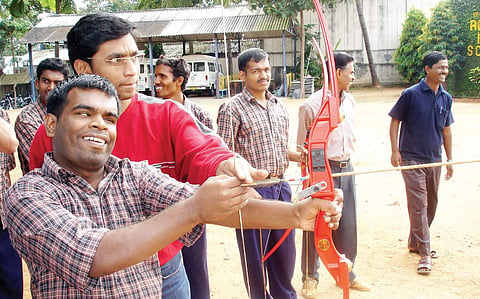

MYSURU: One by one, they stand in position, listen intently to the sound of bell, walk a few steps and shoot the arrow. Some of the archers squeal in delight when they are told they’ve hit the bull’s eye. Some want to go to the target board and feel the circle. And when they do, this group of visually challenged archers senses a triumph of belief. It’s a belief instilled by DSD Solanki, the man behind this innovative project.
Having been in the field of adventure sports since his childhood, the 44-year-old has conducted more than a 100 archery camps. He began the camps as a recreational tool for youngsters. One day he thought if ordinary people with no skills in archery could wield the arrow and even excel in it, why not involve the visually challenged too. This motivated him to impart archery training for the visually challenged. Solanki discussed the idea with people working for the visually challenged and chalked out the techniques of teaching them archery.

To his surprise, he found that the lack of sight wasn’t a big barrier for them as the visually challenged equipped themselves with skills that overcame this perceived handicap. “I found it was more interesting and easier to teach them to hone their skills in archery. They don’t have vision but their other sensory organs are strong and they concentrate better than those with sight,” he says. The group of visually challenged archers have it all in their mental map: the bow, arrow, position, sound of bell, wind speed, flags, rope and target.
The sound of the bell and the arrow is let off in perfect synchronicity. Going down the memory lane, Solanki recalls, “When I used to go on expeditions, it is mandatory that we keep the trekkers or mountaineers engaged in some activities. When we went to Chandertal expedition in Himachal Pradesh in 2005, we took the bow and arrow and explored the possibilities. It worked out better and since then we have kept it as recreational activity in our programmes.”
For the past couple of years he has been conducting competitions for orphans, visually challenged and destitute children in Mysuru, Bengaluru and Hassan. “We have been receiving good response,” says Solanki, whose repertory in adventure sports includes trekking, parasailing, gliding, skydiving, flying, rock climbing, kayaking, rafting, scuba diving. Solanki says the constant support from Rotary Mysore Midtown and Muniraju, a retired employee of the National Association of Blind, has helped him and his team impart the skills. The concentration, observations and passion of the blind are worth appreciating, he says. “We had lot of fun during the camp.
Though it was a unique experience, we wondered how we could hit the target without seeing. But Solanki sir motivated us describing how the champions go blindfolded and set records. This infused confidence in us and we took part in the archery camp,” adds Raghavendra, a visually challenged person. “My happiness knew no bounds when I hit the blue target. The camp was a different experience altogether and I can’t thank Solanki sir enough for giving us this opportunity,” says Soundarya.
Solanki, who is also honorary secretary for Tiger Adventure Foundation, visits various schools, colleges and teaches the young about archery, sometimes involving the parents too so that awareness about archery is created among public. Solanki and his team sources the bows from Korea, while the bamboo arrows are procured from Delhi. “Our aim is to expose them to archery. Whether the children want to take it up as a competitive sport is left to them,” he says. Lohit, an archer, says the experience has been worthwhile for the trainers too. Dr LP Ravi Kumar, Principal, Harvard School of Excellence, Hassan, says exposing the students to such activity helps them deal better with the challenges ahead.