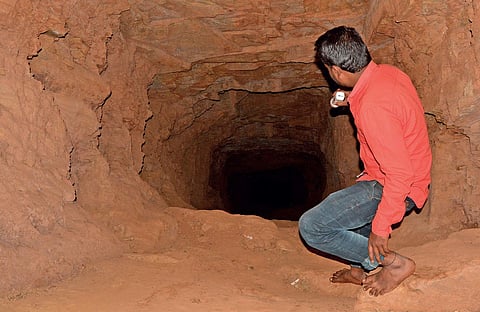

GADAG: They think they are sitting on a gold mine and hope they will strike gold every time they venture into some abandoned caves in their village. They go deep inside the caves, armed with just a rope to scale down the vertical pits and a torch to light their way. Sometimes, the villagers claim, they even camp inside the caves for two days looking for anything glittery.

As you travel 15 km south of Gadag towards Lakshemswar town, you will find a tiny village named Kanavi-Hosur. The village has less than a thousand population, but the people here are known for their unique occupation. They mine gold and other precious metals from the century-old abandoned gold mines.
You ask anyone in the village to show these caves, they pretend ignorance. Maybe they don’t want to lose the leftover gold deposits.
The entire gold mining area in this village sits on the foothills of Kappatagudda, which has deposits of gold and diamonds. British mined here first in the 1900s, and the mine was shut during the 1990s by the last operator Bharath Gold Mines Ltd. Since then the villagers in and around Kanavi-Hosur wander inside these caves in search of precious metals.
The village has at least six such caves, of which two are open. The cave that is located just outside the village is 500m long and stretches underground on both sides. The mouth of the cave has a steep incline which leads to a platform between the walls of the old mine. A dark and deep round pit of 30m lies ahead, after which the tunnel takes a turn towards the left. The mining caves had other openings too but due to poor maintenance many of the caves have now been shut.
The cave that is open for the ‘mining’ is used by villagers to make some small money. Their gold digging has now come under the scanner of the district administration which plans to shut the cave openings to avoid any untoward incidents. Though villagers claim that two village boys who went searching for gold in these caves never returned, the local police and administration say these are rumours floated to ensure nobody goes near the caves.
Though gold mining in abandoned caves sounds exiting, the diggers sometimes return without any luck. They look for the reefs on the walls of the caves and try to collect the mud. If they sight anything glittery they pocket it as well. They pack food, water and carry a torch when they venture inside the caves.
Some villagers claim that they go inside for two days to get gold or any stones that are valuable. Most of these caves are above the water table, hence not filled with water. But the villagers have located some stretches where there is knee-deep water. As the amount of oxygen decreases, the diggers proceed slowly when they move inside the caves.
The gold deposits were higher during the time when the mine was shut. Earlier reports also speak about these caves and surrounding areas having diamonds till 1960s. But currently the villagers try to dig newer areas underground to try their luck. Once the right mud or stone is separated the booty is sold to the local goldsmiths. The goldsmiths extract the metals by using chemicals. Depending on the extract, the amount paid to the digger varies from `500 to `15,000.
“When we were young it was a common sight to see tribal women walking along the streams in and around Kappadagudda. Whenever there was rain, the number of metal seekers used to increase. After the top soil is lost in the rains many glittering pieces used to emerge along the streams. The metals used to be collected and sold in Gadag market where merchants from Gujarat (who lived in Hubballi and Dharwad) used to buy them from the collectors. But as the deposits decreased, the number of collectors too came down,” recalls Indrajit Ghorpade from Deccan Conservation Foundation.