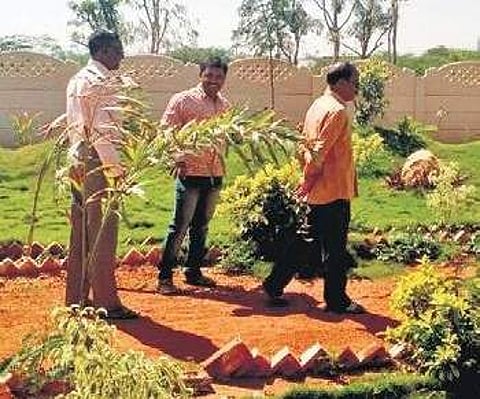

GADAG: It is not often that visitors to any city are asked to pay a visit to the local graveyard to soak in the beauty of the place. While visiting the tomb of a famous personality might be a reason for tourists to enter graveyards, in Betageri, the graveyard itself is the central attraction.
And not without good reason according to locals, who recall a time when the Betageri graveyard, spread out over 22 acres, was a drab and dreary place. Called ‘Muktidham’, this place would once evoke feelings of panic and fear among residents, but now brings them nothing but joy.
In the last two years, residents of Betageri, the twin city to Gadag, have worked together with the authorities to transform the graveyard into a place that gives town residents a soothing view. Around 3,000 saplings, planted two years back at the entrance of Muktidham, are now fully grown and provide a canopy for visitors.
Hundreds of people visit the graveyard daily and on weekends, the numbers are higher. From walkers and joggers to groups of students looking for some afternoon shade, this graveyard has it all. To encourage more people to visit, the local administration has even installed new extra-large benches which provide a place to rest while walking around the gardens.
“It is a very cool place to visit during the day and we come here daily and spend at least two-three hours under the shade. We bring along snacks and biscuits with us,” says Ganesh Nandikolmath, a student from Kurattipete in Betageri.

Located beside the German hospital on the outskirts of Betageri, the graveyard was jointly developed by the Public Works Department, the Muktidham maintenance committee and the Nirmiti Kendra, Gadag. Two mini gardens have also come up near the cremation centre, making the once-barren landscape, look much greener.
At the centre of the mini gardens sits a mantapa. The Gadag-Betageri Municipal Council (GBMC) chipped in and installed 4 CCTV cameras to keep an eye on visitors while the Gadag Forest Department has deputed two employees to look after all the plants in the garden. Three employees of the maintenance committee help with keeping the graveyard clean. The total expenditure on Muktidham so far has been Rs. 4.5 crore.
With schools on holiday, the graveyard parks see many youngsters making a beeline for it. They spend their day there in addition to the ‘regulars’. “Earlier we used to go to the stadium for our morning walk, but now we have been coming here for the past 15 days. This place was a barren land earlier and now it feels like entering a different world altogether,” says B B Malagitti, a retired professor, who visits the park every day with 12 other walkers.
The graveyard itself has both cremation and burial facilities and caters to people of all religions. While one has to pass by the lush greenery to enter the crematorium grounds, it is not necessary to cross the grounds to enter the gardens.
Social activist behind transformation
While several agencies can be credited with the transformation of Muktidham, one social activist is the driving force behind it all. Ganeshsingh Byali, the president of the Muktidham Committee, initially took up the mantle of recreating Muktidham to make it attractive to visitors.“We have made the place a model and a graveyard like this is a rare find. I would like to thank the GBMC for installing cameras here to help us keep a vigil and maintain cleanliness. Some people still throw plastic around the park and we are now telling everyone at the entrance itself to keep the park clean,” Byali says, while sitting on a bench and looking out at the park with pride.
Bicycling flourishes amid greenery
With a nice walking path and lush green surroundings, the graveyard has also become a favourite haunt for bicyclists who throng the park daily. Children also use the lack of traffic to learn how to pedal a bike.