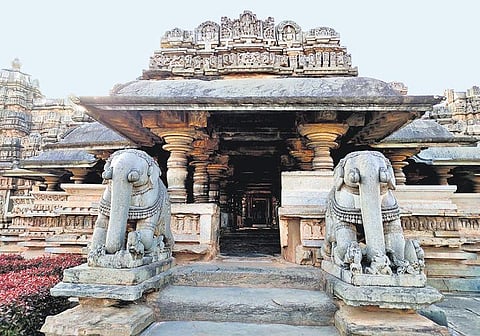

CHIKKAMAGALURU: It is an architectural marvel tucked away in Belavadi village in Chikkamagaluru district, just 10km from the world-famous temple of Halebid. The Veera Narayana Swami temple stands testimony to the Hoysala style of architecture. What is more interesting is the residents living around it make us turn the pages of history.
Although Belavadi village is beautiful in its own way, it does not see many visitors but attracts only art lovers interested in taking a look at the exquisite mantapas, decorated ceiling panels and roof, the bell-shaped pillars and the majestic elephant carvings. Unlike other Hoysala temples in Karnataka, the Veera Narayana temple is surrounded by some 300-400 houses with some so closely situated to the temple that one can just jump into the temple complex.

Venkatacheliah, 78, is one such resident whose quaint abode with its age-old walls and sloping roof has stone pots, bathing accessories and storage vessels. It is surprising how his wife and aunt have the same love for history and have provided all the support in retaining these structures from the olden days. His wife uses all these implements in her day-to-day household work without any complaints. A typical Malnad style house with a big outer courtyard, Venkatacheliah’s house has all the simple necessities of life that is needed for a family. In fact, the house shares a compound wall with the ancient temple.
He says with pride, “Most of our household accessories like grinding stones, grain and water storage vessels are 125-150 years old. The bath tank which was used for storing water has many a time served as a storage for cereals. I have maintained them with care.” Other family members add, “We have retained them as they were in the olden days and not replaced them with modern plastic containers or concrete structures. Even this house is more than a 100 years old while we have a very ancient well inside our compound. It may be older than the house.”
Venkatacheliah says that Belavadi village once had about 400 families living around the ancient temple built in the 12th century. So, one can see many dwelling units that are situated around the temple but they are on lands granted by the Mysore Wadiyar Kings. It is said that land grants were made in appreciation of various kinds of works done by the local people for the temple. So, land was granted to priests, teachers, traditional artistes, musicians, farmers, masons and sweepers.
However, Venkatacheliah laments that out of the 400 families, only 25 are left as most of them have migrated to Bengaluru, Mumbai, European countries and the US. Even as he relates the history of Belavadi village and its temple, he says there are only a few houses that have retained their heritage and one such is his house. For the residents of Belavadi village, it is a big dilemma as their houses fall in the Inam lands granted by the Mysore Kings to Sringeri Mutt.
Living in very close proximity to the temple for generations, even their lives are intimately connected with the Veera Narayana temple which brings in devotees every day from nearby villages. Residents say that authorities had even asked them to vacate their houses and lands as 100 metres of land was required around the temple to give it more protection. Since the temple is an ASI monument, no house owner has been allowed to take up renovation works around the temple.
In view of this rule, Venkatacheliah says many houses abutting the Veera Narayana Temple have been untouched. “We are helpless but it is necessary to protect such a glorious heritage. We want people to come and see this architectural masterpiece which is the largest Hoysala temple in the state.” Venkatacheliah says, “I will not mind leaving my house for Lord Veera Narayana but we need government support to start a new life away from Belavadi.”
EPIC VILLAGE
Steeped in history, the scenic Belavadi village was once known as “Ekachakranagara”, and this has found mention in the epic Mahabharata, local residents inform. A local festival is also celebrated every year in remembrance of the slaying of demon Bakasura by Pandava Prince Bhima