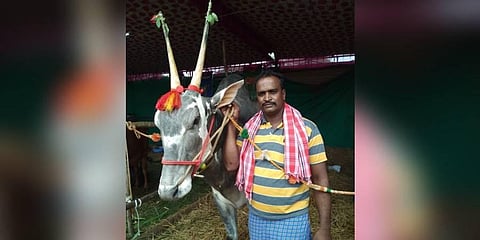

MYSURU: When was the last time you heard that people are flocking to catch a glimpse of a bull? It is the Hallikar breed bull at Dasara Krishi Mela expo which is attracting huge visitors as the breeders are ready to pay over a crore to purchase the indigenous breed bull.
Boregowda, the owner of BG Banduru Kuri farm in Malavalli taluk in Mandya district, is the owner of the bull Krishna, who is 4 years and 7 months old. Krishna was first owned by Ravi Patel from Kalenahalli in Mandya, and from him, gangster-turned-social activist Muthappa Rai bought him for `4.5 lakh.

“The calf was weak, so I purchased him for `2.75 lakh. I fed him nutritious food, and now he is 6.5 feet in height, 8 feet in length and weighs 900 kg. Earlier, some breeders who came to my farm, quoted Rs 6 lakh, and recently, former animal husbandry minister KN Nage Gowda’s son Arun Gowda made an offer of Rs 68 lakh. A farmer Papanna Gowda from Dasanadoddi village in Malavalli said he will pay Rs 1 crore. However, I want the bull to enter the Limca Book of Records, and then think of selling him if I get a good price,” he said.
Krishna is known for his breeding. Boregowda sells his semen to farmers. Each semen stick costs `1,000, which is kept in a liquid nitrogen container. Boregowda is the only farmer in the country who sells Hallikar bull semen for breeding. He has consulted Karamveer Singh, the owner of Yuvaraj bull from Haryana, regarding the semen storage mechanism.
Wadiyars thanked
Boregowda lauded the Wadiyars for protecting the breed, which was on the verge of extinction due to inbreeding and hybridization, by opening gaushalas in the region. Hallikar breed bulls are found in Mysuru, Mandya, Chamarajangara, Hassan and Tumakuru districts, and are known for their their strength needed for ploughing. “Due to modern ploughing machines like tractors, tillers, rotary, farmers have stopped rearing the bull,” he said.
Helps in organic farming
The demand for semen of Hallikar bulls is for breeding as the milk contains A2 protein which is salient to fight kidney-related ailments, and helps to keep hypertension and diabetes in control. “The milk from Hallikar cattle is used for organic farming. Cattle urine, milk, dung, curd, ghee are prepared from it for organic farming,” he said, adding that when a mother is unable to breastfeed the child, the family members buy milk from Hallikar cows. “Hallikar cows give around 2 to 3L of milk. I sell the milk for `100/L, ghee `250/L and butter `1,600. The urine is sold at `10/L,” he said.