
It was in January 2014 that an American evangelist -- Toufik Benedictus “Benny” Hinn -- was forced to cancel his visit to Bengaluru as he was allegedly going there on a ‘faith-healing crusade’. The cancellation followed protests from Hindu right-wingers as well as rationalists and intellectuals. The latter opposed the visit, questioning the practice of faith-healing from the rationalistic point of view, while the former feared that Hinn’s “crusade” was in fact a meeting for conversions.
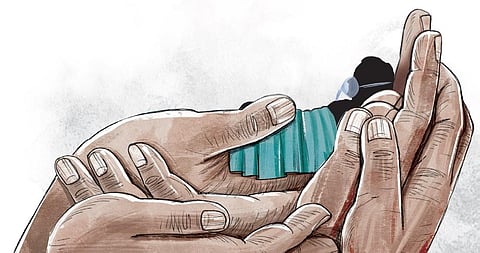
Faith healing is believed to involve spiritual intervention to bring about physical healing. Many choose it over the modern medical system out of sheer faith of being cured through what they believe to be “spiritual means” at much lower costs as compared to treatment by modern medicine. And all this happens across religious lines.
Nine years before his visit was cancelled in 2014, Benny Hinn had held a ‘Miracle Crusade’ at the Jakkur airfield in Bengaluru that was attended by nearly 10,000 people. But many went on the rampage after it was alleged that he was a fraudster. In January 2014, the Karnataka High Court, taking note of the 2005 incident, directed the police to ensure all precautionary measures to prevent a repeat of the earlier incident. But Hinn, sensing trouble, cancelled his visit.
In the first week of February 2023, two infants, just three months and two-and-a-half months-old, died on February 1 and February 4, respectively, after they were subjected to a faith-healing practice called ‘Daagna’, where a child is poked with hot iron rods to drive away diseases. The infants, both girls, were suffering from pneumonia, and instead of being shifted to modern medical facilities, they were taken to two faith-healers separately. The first incident was reported from Samatpur village of Shahdol district in Madhya Pradesh, while the second was from that state’s Kathotia village in Sinhpur district. The faith-healer in the second incident, a woman, was arrested, while the one in the first, also a woman, has gone missing.
Unfortunately, faith-healing is rarely reported, although it is known that many people, especially in rural areas – literate and illiterate – prefer faith-healing. Karnataka, a state reputed for professional education -- both medical and engineering, is no exception to people taking to faith-healing. As most cases go unreported, there is no estimate of the number of such cases in the state.
In Belagavi, faith healers have captivated the minds of many suffering from various diseases and their families after “convincing” them that modern medicine would not heal their ailments. The victims are often uneducated. But there is a disturbing trend of educated people, too, falling into this trap, say doctors in the district.
Dr Madhav Prabhu, Consultant Physician and Cardio-diabetologist, Belagavi, told The New Indian Express, “Faith is a universal phenomenon. It is a human instinct to resort to faith when in despair. As a doctor, I am not an atheist, but I am not superstitious, and this is the distinction not everyone can maintain. Faith can be positive and many times I encourage my patients and their relatives to have faith in God and time, because it gives them confidence, something which is required when in peril. This faith, however, is subject to exploitation by certain ‘magical healers’ and religious con men who disguise themselves as saints.”
Karnataka too has witnessed cases like in Madhya Pradesh, says Dr Prabhu. “Although under control on the surface now, this evil persists in the underbelly of our society. It is commonplace to see patients, who are suffering from jaundice, come with branding marks made with marking nuts or ‘bibbe’, as they are called in the local language. The patient remains convinced about the jaundice-healing capabilities of this practice, but lands up with fulminant hepatitis which can be fatal. The patient could have been easily saved with modern medicine,” he says.
Couples who suffer from infertility are the worst victims of faith-healing as remedies range from local practices to human sacrifice – a life taken in the hope of giving new life. Since having a progeny is considered so important in our society, faith healers fully exploit such innocent couples, says Dr Prabhu.
Hassan district has more than adequate number of primary health centres with enough doctors. Yet, people prefer faith-healers to get immediate relief. Sarvamangala, who took her three-year-old daughter suffering from skin-related problems to a temple, says she offered curd rice to the goddess and her daughter recovered in three days. She blamed higher costs at government hospitals for her preference to faith-healing.
In Udupi district, which also has a well-developed medical facility network, faith-healing cases go unnoticed as victims hide it. Social activist Dr MV Holla says even some doctors use old analgesics and resort to treatment.
Dr Holla is of the view that spiritual healing, reiki, acupuncture etc, which do not cure diseases, should be regarded as ‘faith healing’. He urged the state government to keep a check on all such ‘treatment centres’ from mushrooming. “Magnetic beds were sold in Hubballi for Rs 1 lakh and some people bought it to get relief from pain,” he says.
Though Mysuru is considered an intellectual hub, people here continue to be victims of ignorance and superstition. The rural belt of Mysuru, Chamarajanagar and Mandya districts continues to see people exploited in the name of faith-healing and black magic. While the Kollegal belt is infamous for black magic, rural parts of HD Kote and Periyapatna in Mysuru district, Gundlupet, Hanur and Kollegal in Chamarajanagar district continue to see faith-healers taking advantage of innocent people and luring them with the assurance of cures.
“People in rural pockets still believe that prayers have divine powers and can do miracles to cure disease. But practically, no such things happen. Though there is scientific evidence against faith-healers, people still fall for them. As such cases go unreported, no action is taken against them by the authorities, and they are encashing it,” says Anjan Kumar, a physics lecturer.
A social activist in Dharwad, another intellectual hub of the state, says on condition of anonymity that the delay in attending to patients, and lack of facilities at government hospitals force rural people to adopt such practices. “The healthcare system is out of control and hefty bills worry rural people. The proper facilities, adequate number of medical staff and a robust system to spread scientific awareness can help people gain faith in modern medicine,” he points out.
With inputs from:
Divya Cutinho/Mangaluru;
Mallikarjun Hiremath/Dharwad;
Tushar A Majukar/Belagavi;
Prakash Samaga/Udupi;
BR Udaya Kumar/Hassan;
Karthik KK/Mysuru;
V Velayudham/Kolar