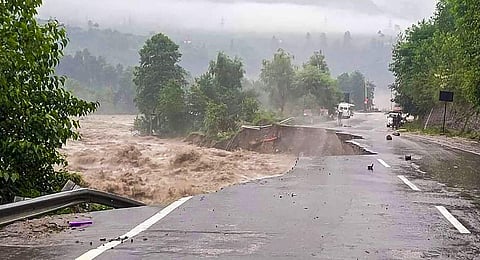

BENGALURU: As per the report released by the Council on Energy, Environment and Water (CEEW), on Thursday, 14 Indian states have better resilience to floods due to availability, accessibility and effectiveness of early warning systems.
The report stated that states such as Assam, Odisha, Sikkim, Uttar Pradesh, Uttarakhand, Jharkhand, and Kerala tops the list. The report titled- ‘Strengthening India’s Disaster Preparedness with Technology: A Case for Effective Early Warning Systems’, highlighted that early warning systems were a critical component of building climate resilience as the country is experiencing extreme weather events such as floods and cyclones recently. These early warnings are also a part of disaster risk reduction, a key focus area under India’s G20 Presidency.
The report also noted that cyclone warnings were available to 100% of the exposed population in the country. It noted that coastal states such as Andhra Pradesh, Odisha, Goa, Karnataka, Kerala and West Bengal were at the forefront of building resilience by establishing effective cyclone early warning systems. As cyclones increase in frequency with warming oceans, inland states in the path of these cyclonic storms will also need to strengthen resilience.
The 2021 study found that 27 Indian states and union territories were vulnerable to extreme hydro-met disasters and their compounded impacts. “The country suffered damages worth Rs 62,000 crore due to extreme flood and cyclone events in 2021 alone.
Currently, India’s cyclone early warning systems are much more robust than its flood ones. But as each state faces an increase in the frequency and intensity of climatic extremes, it is important to build effective early warning systems for all,” quoted the report.
The CEEW study calculated resilience to floods and cyclones as a sum of availability (presence of early warning stations), accessibility (share of people who have access to information, including phones) and effectiveness (presence of governance and financial frameworks) of early warning systems.