
If a woman suffers from cancer, the priority is treatment to manage the condition and eliminate it, not plan to dress her up in a bridal attire to make her more attractive to all. The latter is how the state government and the civic bodies are treating Namma Bengaluru.
Months before rains came to Bengaluru, the Bruhat Bengaluru Mahanagara Palike (BBMP) was asked to keep the drains open and make the city flood-proof. That obviously did not happen. Instead people heard ambitious plans of tunnel roads for Bengaluru to decongest surface vehicular traffic and a sky deck to attract tourists.
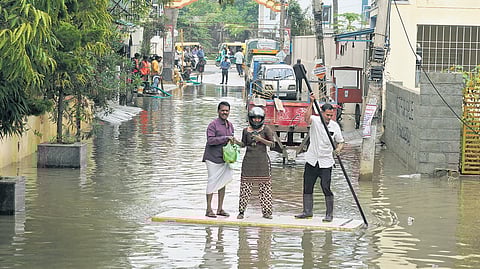
Then October 22 happened. A massive cloudburst on October 21 midnight, lasting six hours into the next day with 40mm rain. Waist-deep water inundated ten residential areas, severely affecting at least 4,000 houses in just the Yelahanka zone and in areas adjoining the Doddabommasandra Lake. The observatory at GKVK, Hebbal (in North Bengaluru) recorded 186.2 mm, the highest single-day rainfall record in October in 27 years.
Although North Bengaluru was the most affected, flooding to a lesser degree was experienced in several other parts of the city as well. Every Bengalurean knows by experience what happens when rains like that hit the city: traffic thrown out of gear; gridlocks and congestion persist for hours; and, as on October 22, many people including school and college kids getting stuck for hours on flyovers and roads.
The instant political reaction to the flooding is worth noting. DK Shivakumar, Deputy Chief Minister and Bengaluru Development Minister, expressed a degree of helplessness, blaming it on “nature”. He even cited examples of Delhi with its high air pollution, and a dry Dubai in the United Arab Emirates (UAE) receiving an entire annual quota of rainfall in a single day in mid-April this year, recording 2.54.8mm in some areas against an annual average of 94.7mm.
Dubai can’t be compared with Bengaluru. Nor can Mumbai, which he did not mention. Mumbai, on an annual average receives 2,318 mm of rain, with a long dry season and a short, rainy wet season (June-September), and is influenced by the Southwest Monsoon and the Western Ghats. The horrendous July 26, 2005 deluge due to a cloudburst claiming 1,094 lives after 944mm of rain pounded Mumbai in just 24 hours, comes to mind. Although rains there are much dreaded, flooding grievances and related miseries for Bengalureans are repeated over longer duration annually though with lesser rains than Mumbai.
Average annual rainfall in Bengaluru has increased to 1,200mm at present from 900 mm in the 1900s. The annual rainfall since 2020 has been over 1,200mm. In 2022, the city received 1,957mm rainfall, the highest in
122 years. Bengaluru’s strategic location makes it receive rains almost throughout the year. Despite that kind of exposure to rain, the city administration has done precious little to make it flood-proof.
That probably ushers helplessness …even among the political and bureaucratic circles. Which is why probably Shivakumar and BBMP Chief Commissioner posted their photos standing in ankle- to knee-deep water — an effort to show solidarity with the people, who in thousands were struggling to get out of water with the help of rescue teams.
Politicians cutting across party lines, please note: there is more helplessness and frustration among the people who keep taking the brunt. Frustrated for being subjected to the same miseries year after year without respite. And it’s happening in Namma Bengaluru, which is projected as a global city to attract higher investments. That too, in a state with among the highest number of engineering colleges in India, and hosting the legacy of an engineering colossus like Sir M Visvesvaraya.
What else can one feel but shame towards the predicament that we have put our once-beautiful city in? People might as well consider being equipped with their own dinghy boats and life jackets. Probably some subsidy from the government is welcome. A flavour of guarantees?
The political tik-tok behind all this is a matter of debate, and can go on an on….without conclusion. We have seen scams (including sexual) and accusations, ideological mudslinging, political chess games, personal political attacks…and we are lured into keeping an eye on numbers pertaining to which party gets how many through the pull-and-push of political power play — the cliched “Will the government fall?”, or “Will the CM change?”
All that may be good for political careers for entities who have for a lifetime been consumed by politics. But what about the people, the ones politicians go begging to for votes? Aren’t they the ones suffering now? Aren’t they the ones politicos are trying to convince that the government will now act. But will it?
The political players need to understand that ideologies do not matter when it comes to people’s welfare, utility services, safe environment, and productive work and living spaces. Rain and floods don’t have ideologies. Political parties do. People have memories. And those decide the fate of politicians.