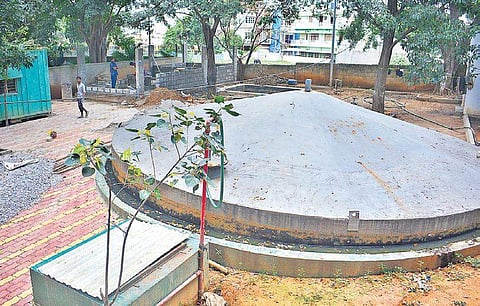

Often, worrisome situations can throw up solutions to problems caused by them. In the current scenario, with the war in West Asia threatening shortage of liquefied petroleum gas (LPG), turning towards biogas as the go-to option, is one such.
Biogas is produced from biomass sources like agricultural residues, cattle dung, sugarcane press mud, municipal solid waste, and sewage treatment plant waste. It is an anaerobic decomposition process wherein microorganisms break down organic materials in sealed oxygen-free chambers, called digesters. While biogas can replace LPG, Compressed biogas (CBG) (made by removing carbon dioxide, hydrogen sulphide and moisture from raw biogas), has properties similar to Compressed Natural Gas and can be utilized as green renewable alternative automotive fuel, completely replacing CNG in automotive, industrial, and commercial sectors. Biogas production can be endlessly sustained with the availability of abundant biomass.
Karnataka annually generates 40,31,060 tonnes of municipal solid waste (the volumes are much more if unaccounted waste from rural areas is included); 21,90,000 tonnes of wet/kitchen waste, 16,27,170 million litres of sewage and significantly high agricultural waste and cattle dung, the volume of the latter depending on the size of the livestock. This is a significant volume for sustaining biogas production and replacing LPG for cooking and other energy needs in households as well as various other sectors, replacing conventional energy sources, which are currently threatened due to the war.
But more needs to be done. Clean energy generation is a win-win option. It takes care of the generated waste, which otherwise poses a humongous challenge over its disposal, especially in a city like Bengaluru, where landfill options are limited. Increasing biogas production kills two birds with one stone – it considerably reduces handling waste disposal, while bringing abundant clean energy alternatives by converting waste to energy. Besides, it also generates local employment involving production and processing of wood feedstock, operation of biogas plants, while promoting self-reliance and improving the quality of life, especially of women and the rural poor.
The welcome result is: reducing – and ultimately eliminating – dependence on LPG, 60% of the country’s demand for which is currently met through imports, 20% of it coming through the Strait of Hormuz, the epicentre of the war. The situation has forced India to look at alternatives to its main suppliers, Qatar, the UAE, Saudi Arabia, and Kuwait – all targeted by Iran in the current war – and increasing LPG imports from the USA, Argentina and Australia to sustain domestic demand, but paying a higher price. In this scenario, biogas is the main go-to option to eliminate dependence on LPG.
As Karnataka is on the verge of formulating a biogas policy, the 2005 IISc study’s valuable observation needs to be heeded by the state government: “Although bioenergy provides significant environmental and social benefits, large-scale shift towards this option cannot be realized in the absence of a whole range of policy measures. A well-established network between the government, local people, NGOs together with technical expertise and financial backup will help in building a society sustaining on bioenergy.”
