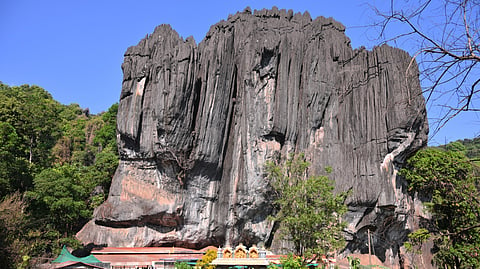

YANA (UTTARA KANNADA): The Geological Survey of India has declared the Yana caves near Gokarna in Uttara Kannada district as a geo-heritage site of national importance.
The scientific community welcomed the move saying it will ensure conservation of the ancient rocks formed nearly 2,700 million years ago.
On the occasion of the 176th Foundation Day of the GSI, the GSI passed a resolution recognising Yana caves as a geo-heritage site of national importance. It announced the move in a letter dated, April 13, 2026.
GSI is the nodal agency for geo-conservation of earth heritage commonly referred to as geo-heritage sites, endowed with geological features of significant scientific, educational, cultural and aesthetic value. It involves identification and recognition of geological treasures as geo-heritage sites.
The rocks nestled within the Western Ghats represent a remarkable example of landscape evolution, shaped by tectonic weathering and karst processes.
Experts push for buffer zones for Yana caves
“The striking rock masses at Yana were formed 2,700 million years ago and are composed of pre-cambrian dolomitic limestone. Over millions of years intense tropical weathering, coupled with chemical dissolution led to the development of characteristic karst features. Yana region hosts 61 distinct karsts and Bhairaveshwara Shikhara and Mohini Shikara are the most dominant peaks. These two famous paired massive black monoliths are also linked with popular mythological narratives and well known for pilgrimage,” the letter read.
MD Subhash Chandran, consulting scientist, Centre for Ecological Sciences, Indian Institute of Science, Bengaluru, said it is a commendable step.
“It is a fine forest with a geological monument and it is also a perennial source of water for Aghanashini river.
Because of lime rich dolomite, water resources here are perennial. They keep on releasing water. It’s a timely declaration, an eye opener for greater protection for Yana and its surroundings. A buffer zone should also be considered for protection and for the drainage basin of the Yana rivulet and its biodiversity,” he said.
These two famous paired massive black monoliths are also linked with popular mythological narratives and well known for pilgrimage,” the letter read.
MD Subhash Chandran, consulting scientist, Centre for Ecological Sciences, Indian Institute of Science, Bengaluru, said it is a commendable step.
“It is a fine forest with a geological monument and it is also a perennial source of water for Aghanashini river.
Because of lime rich dolomite, water resources here are perennial. They keep on releasing water. It’s a timely declaration, an eye opener for greater protection for Yana and its surroundings. A buffer zone should also be considered for protection and for the drainage basin of the Yana rivulet and its biodiversity,” he said.
