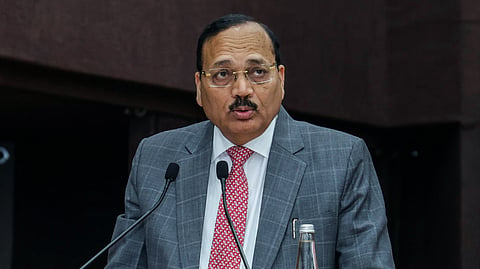

Chief Justice of India Surya Kant on Saturday cautioned that while the judiciary embraces technological tools, particularly artificial intelligence, it must do so with a clear understanding of their limitations. He urged judicial officers not to be “afraid” of AI, but to use it as an aid rather than a substitute for human judgment.
Speaking at the 22nd biennial state-level conference of judicial officers in Karnataka, themed “Reimagining the Judiciary in the Era of Artificial Intelligence,” organised by the Karnataka State Judicial Officers Association, the CJI stressed that technology should enhance judicial functioning without undermining the core human values that underpin the justice system.
“Do not be afraid of AI,” Justice Kant said, drawing an analogy with complex legal adjudication. “When a case involving complicated facts and legal questions is placed before you, you apply greater thought, patience and diligence. The same approach is needed when using AI tools—carefully and consciously, ensuring that the judge within you remains independent.”
He emphasised that AI must not influence judicial reasoning, but rather support it in a controlled and responsible manner.
The Chief Justice acknowledged the significant potential of AI in improving efficiency within the judiciary. He noted that it could assist in legal research, case management, data organisation, and reducing administrative burdens that often consume valuable judicial time. With proper training, he said, judicial officers could use such tools to increase productivity and devote more attention to adjudication.
However, he issued a strong caution regarding the limitations of AI systems. “AI operates on patterns, algorithms and existing datasets. It does not possess judgment in the human sense, nor can it engage with ethical, social and moral dimensions that are central to judicial decision-making,” he said.
He underscored that judging is not merely an analytical exercise but one that is reflective, contextual and grounded in constitutional values. Over-reliance on AI, he warned, risks reducing judicial decision-making to mechanical outputs, thereby weakening its depth, independence and integrity.
The CJI also pointed to emerging concerns over inaccuracies generated by AI systems, including fabricated precedents, incorrect citations and entirely fictitious legal propositions. Describing these as “hallucinations,” he said such errors were not minor technical glitches but issues that strike at the foundation of the judicial process, which depends on accuracy and trust.
“If left unchecked, they can mislead arguments, distort legal reasoning and compromise the quality of adjudication,” he cautioned.
He further warned of the potential misuse of AI tools to generate misleading pleadings, frivolous claims or superficially persuasive but substantively weak submissions, noting that such practices place additional strain on an already overburdened judicial system.
Justice Kant stressed that responsibility in judicial work cannot be delegated to machines. “Technology must be approached with discernment, not deference,” he said, adding that any material generated through AI must be independently verified and scrutinised by judicial officers.
Reaffirming the centrality of human agency in the justice system, he said, “Justice is, and must remain, a human endeavour. It is shaped by reasoning, guided by values and enriched by experience. No technological advancement can replicate the moral judgment and intuitive understanding at the heart of judicial decision-making.”
He added that the judiciary’s future will depend on its ability to adapt to technological change without losing its institutional identity. This, he said, would require continuous learning, reflection and a sustained commitment to judicial excellence.
“We are at a moment of transition, and the choices made now will shape the judiciary for years to come,” he said. “While tools and methods may evolve, the fundamental responsibility remains unchanged—to deliver justice that is fair, accessible and humane.”
Calling for introspection within the institution, the CJI said the time had come for the judiciary to pause and reflect—not out of hesitation, but as an act of responsibility—on how it engages with emerging technologies while safeguarding its core principles.
Karnataka Chief Minister Siddaramaiah, Supreme Court judges B V Nagarathna and Aravind Kumar, and Chief Justice of the Karnataka High Court, Vibhu Bakhru, among others, were present at the event.
(With inputs from PTI)
