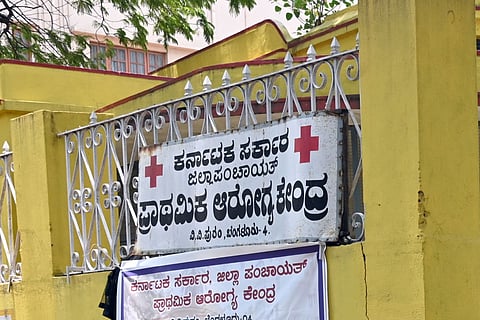

BENGALURU: Mounting vacancies in Karnataka’s primary healthcare system are forcing frontline workers to take on multiple roles, with Primary Health Care Officers (PHCOs) now being asked to shoulder the responsibilities of Community Health Officers (CHOs), triggering concerns over workload, training gaps, and patient care.
In 2024-25, as many as 1,194 CHO posts remain vacant out of 6,780 sanctioned positions. At the same time, 2,949 PHCO posts are also unfilled, pointing to a wider human resource crisis at the grassroots level.
PHCOs, earlier known as Auxiliary Nurse Midwives (ANMs), are primarily trained in reproductive and child health. However, a recent order by the Department of Health and Family Welfare has directed district officials to obtain consent from PHCOs to take on CHO duties in centres where vacancies persist, instead of filling these posts.
Experts say the move reflects deeper systemic issues. “There is a clear mismatch of capacity and skills. CHOs are trained as mid-level healthcare providers focusing on non-communicable diseases, while PHCOs are trained mainly in maternal and child health.
Simply transferring responsibilities is not a sustainable solution,” says Dr Swathi SB, public health practitioner and member of Sarvatrika Arogya Andolana Karnataka (SAAK). She added that the approach risks weakening the system further. “When both cadres themselves are understaffed, redistributing roles only increases pressure without strengthening healthcare delivery,” she noted.
Mamit Gaikwad, State President, State CHO Union, strongly opposed the move. “CHOs are BSc Nursing graduates with a bridge course in community health, while ANMs undergo a two-year diploma focused on maternal and child health. Assigning CHO duties to PHCOs is not appropriate,” he said. He warned that service delivery could suffer. “If one person is expected to manage OPD services, field visits and non-communicable diseases, it will definitely impact patient care,” he said, adding that over 300 CHOs resigned last year and another 200-300 this year due to job insecurity.
From the PHCO side, concerns are equally strong. Chandrika Dammalli, State President, Karnataka State Primary Health Care Officer Association, said, “We are already managing multiple centres due to staff shortages. Now we are being forced to take on CHO duties without proper training. This will affect both our existing responsibilities and the quality of care provided to patients.”
With both CHO and PHCO posts facing vacancies, experts say the state must prioritise recruitment and maintain clear role definitions, rather than relying on temporary fixes that could overburden an already stretched workforce.
