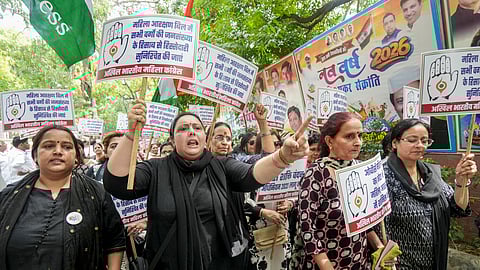

In a major political development, the proposed Constitutional amendment linked to the implementation of women’s reservation framework was defeated in the Lok Sabha on Friday, after it failed to secure the mandatory two-thirds majority required for passage. The Women’s Reservation Bill sought to operationalise the provision for reserving 33 per cent seats for women in Parliament and state legislative assemblies.
However, divisions among political parties over issues such as linking of the Bill to census and delimitation, and the timing of implementation led to the amendment falling short during voting in the special session of Parliament on Friday.
According to political observers, the Karnataka Legislative Assembly would have seen an increase of seats by at least 90 if the quota bill linked to delimitation of constituencies came into force and the number of Lok Sabha segments from Karnataka would have risen in number by 13 to 14.
Opinion is, however, divided about the quota bill as all the opposition parties opposed its linking to delimitation of constituencies while many political observers felt the bill would be effective only if it was linked to the census plus delimitation.
The Women’s Reservation Bill, 2023, was passed by Parliament as the 106th Constitutional Amendment to enhance women’s representation in legislatures. The legislation provides for one-third reservation for women in Lok Sabha and State Legislative Assemblies.
Under the provisions of the Bill, 33 per cent of seats in Lok Sabha and all state Assemblies will be reserved for women. The quota will also apply to the Delhi Legislative Assembly. One-third of seats is already reserved for Scheduled Castes (SC) and Scheduled Tribes (ST) will be earmarked for women belonging to these categories.
The legislation specifies that reservation will come into effect only after the completion of the next census and subsequent delimitation exercise. Reserved constituencies for women will be rotated after each delimitation to ensure wider representation across regions.
The Bill provides for reservation to remain in force for a period of 15 years, though Parliament may extend it further if required. However, reservation does not apply to Rajya Sabha or State Legislative Councils. The legislation is aimed at increasing women’s participation in law-making bodies, where their representation has historically remained limited.

Men hold the strings
Karnataka continues to see limited representation of women in both the Legislative Assembly and Lok Sabha, with political observers noting that parties often field women candidates primarily from influential political families rather than promoting grassroots leadership.
Despite growing discussions on gender parity, women’s presence in the Assembly remains modest. Analysts argue that the selection process within major political parties tends to favour candidates with established political lineage, leaving fewer opportunities for first-generation women leaders.
Among the few women Members of Parliament from the state, two come from prominent political backgrounds. Davangere MP Prabha Mallikarjun belongs to the family of senior leader Shamanur Shivashankarappa, while Chikkodi MP Priyanka Jarkiholi is from the influential Jarkiholi political family of Gokak. Their selection, observers say, reflects the broader trend of dynastic influence in women’s candidature.
Political observers point out that the scenario could have been markedly different had the proposed Women’s Reservation framework been implemented. The reservation of seats for women in Parliament and State Assemblies was expected to open doors for candidates from diverse social and economic backgrounds, thereby broadening representation beyond established families.
Several people argue that such a shift would not only increase the numerical presence of women but also alter the nature of electoral politics in Karnataka by encouraging participation from grassroots activists, professionals, and leaders from marginalised communities.
With the debate over women’s representation continuing, stakeholders stress that meaningful legislative measures are needed to ensure women from across sections gain access to the political mainstream.
Women’s quota bill and Karnataka Assembly
The proposed women’s reservation framework, which faced a setback in Parliament, would have significantly reshaped representation in the Karnataka Legislative Assembly, if implemented. The Women’s Reservation law seeks to reserve 33 per cent of seats in all state Assemblies, including Karnataka. The state currently has 224 Assembly constituencies, meaning around 74-75 seats would be earmarked for women after implementation.
The reservation would also apply within seats already reserved for Scheduled Castes and Scheduled Tribes, ensuring representation of women from these communities. The reserved constituencies would be rotated after delimitation, bringing different regions under the quota over time. Political observers note that the defeat of the amendment in Parliament delays the possibility of reserving seats for women in the Karnataka Assembly.
Noted politician and former MLC Mahantesh Kavatagimath described the bill as historic if implemented, and said it would make way for the aggressive development of the country with women in frontline politics. “Once the bill is implemented, women folk will have a major say in all the important affairs and policies of the government and we will also see the emergence of a large number of women leaders across the country,” Kavatagimath adds.
The number of parliamentary constituencies in Karnataka will increase by 12 to 14 seats, and assembly segments by about 90 to 100 seats once the bill comes into effect, he said, adding that the bill would change the face of Karnataka politics if implemented.
Priyanka Satish Jarkiholi, Congress MP from Chikkodi, has voiced strong opposition to the 2026 delimitation bill which was linked to the women’s quota bill, warning that it could disturb India’s federal structure and political balance among states.
She cautioned that southern states, which have performed well in family planning, education and healthcare, could lose parliamentary representation if seats are allocated purely on population basis. She noted that states with larger populations would gain more seats, potentially upsetting the delicate federal balance.
Such a shift, she said, could create regional bias in central policymaking and lead to neglect of developed states. Belagavi MLA Abhay Patil said, “The Congress, which opposed women’s reservation, has today revealed its true anti-women stance by snatching away the rights of mothers and sisters in the country. Shame on Congress.”
Political analysts see setback, not end
Many politicians have termed the defeat of the women’s quota bill in the Lok Sabha as a significant setback, while noting that the broader push for increased representation of women in legislatures remains intact.
Analysts said the voting outcome reflected the absence of consensus among political parties, particularly over linking the women’s quota with census and delimitation exercises.
According to observers, while most parties support greater participation of women in politics, differences over timing and implementation led to the bill’s defeat.
Several Congress leaders pointed out that tying reservation to delimitation complicated the reform and contributed to political divisions. They noted that concerns were raised about potential changes in constituency boundaries and their impact on regional representation.
Despite the setback, several politicians believe the demand for women’s reservation will remain a key issue in future parliamentary debates. They said the development delays immediate implementation but keeps the question of enhancing women’s representation alive in the national political agenda.