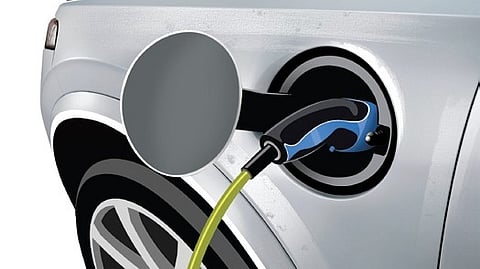

BENGALURU: Bengaluru, the world’s fastest growing metropolitan city, is losing its air quality by the day, and the strain on the city’s infrastructure to accommodate the increasing number of vehicles is evident.
Delhi proposed stopping the registration of three-wheelers with internal combustion engines in 2027 and such two-wheelers in 2028 to encourage electric alternatives in view of the city’s increasing environmental hazards. Similar issues are prevalent in Bengaluru, too. They are preventable, but only if the government considers addressing them before the situation gets out of control.
Experts say that switching to EVs will help the city breathe cleaner air, but this must be implemented in such a way that it does not strain the infrastructure. The switch to EV must be planned, targeted and implemented, while still prioritising shared mobility and public transport to free the roads.
Pawan Mulukutla, WRI India’s executive director for Integrated Transport, Clean Air & Hydrogen, said, “Mumbai now struggles with an AQI of 108, compared to 52 in 2016. Similarly, the average maximum temperature of Bengaluru in 2016 was 30 degrees Celsius, but within a decade, it has climbed to 36 degrees Celsius. All these are pointing towards the same thing.” Mulukutla suggested, “The State must mandate all new vehicles – both public and private – to be electric. All fleets of delivery vehicles and taxis, as well as personal vehicles, must transition.
The people must be presented with a plan and a timeline of this transition. With a target of 2030, people will have enough time to plan and execute the change.” Ashish Verma, professor and convenor at IISc Sustainable Transportation Lab (IST Lab), said the future of sustainable mobility is not only in switching to electric but also in shared and active mobility.
“This targets air quality issues, climate impact and traffic congestion – all at once. Even if we switch all the vehicles to electric, the traffic congestion will still exist, which the city cannot handle. Use of personal vehicles for commuting must be discouraged,” he said.
While the Centre is pushing for a net-zero emissions target by 2070, the Karnataka government has revoked the road tax rebate offered to purchase electric cars.
