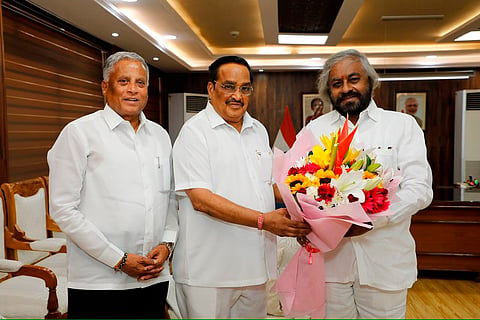

BENGALURU: Rural Development and Panchayat Raj Minister Eshwar B Khandre has urged the Centre to allocate Rs 4708.14 crore for Yettinahole Integrated Drinking Water Project under the Jal Jeevan Mission (JJM). He also urged Union Jal Shakti Minister CR Patil to approve a comprehensive drinking water project for the districts of Bidar and Kalaburagi The projects are aimed at providing drinking water to several drought-prone districts.
Khandre met Union Jal Shakti Minister CR Patil and Union Minister of State V Somanna in New Delhi and requested to bring the Yettinahole Project under the Jal Jeevan Mission.
He said the scheme is designed to provide sustainable drinking water to over 75.59 lakh people across 6,657 villages and also 38 towns in the districts of Bidar, Kalaburagi, Kolar, Chikkaballapur, Hassan, Bengaluru Rural, Chikkamagaluru, Chitradurga, and Tumakuru. Khandre pointed out that all these districts face water scarcity.
Khandre said the Yettinahole project is currently being implemented by the Visvesvaraya Jala Nigam Limited under Karnataka’s Water Resources Department. He said the state government has already completed a major portion of the work. He requested the Centre to contribute 50% of the remaining project cost of Rs 9,416.28 crore to complete the works.
Khandre mentioned that the Yettinahole project has been designed to lift 24 tmcft of water from the upper region of the Western Ghats to drought-hit districts. Of this, around 14 tmcft has been earmarked for drinking water supply including 8.4 tmcft for rural areas and 5.5 tmcft for urban areas. The remaining 9.95 tmcft of water has been allocated for groundwater recharge by filling 527 lakes from these districts.
Projects for Bidar, K’buragi
Khandre said the proposed projects for Bidar and Kalaburagi, estimated to cost Rs 7,200 crore, aims to lift water from the Narayanpur Reservoir on the Krishna River. Once implemented, it is expected to provide drinking water to 28 lakh people across the two districts.
The scheme will cover 18 taluks and 943 villages, with a targeted supply of approximately 200 MLD water. The beneficiary population includes around 6.76 lakh Scheduled Caste (SC) residents and 1.84 lakh Scheduled Tribe (ST) residents.
