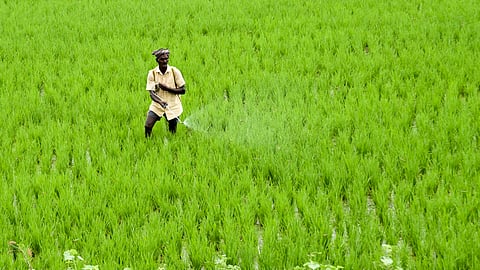

HUBBALLI: Scientists from the University of Agricultural Science (UAS) and Gandhi Krishi Vignan Kendra (GKVK), Bengaluru, have developed a low-cost biochar technology to help small and marginal farmers improve soil nutrition.
SV Suresha, Vice-Chancellor, UAS, said, “Over half of Karnataka’s farmland has fallen below the critical soil organic carbon threshold – a crisis we can no longer defer. Biochar turns residues that farmers burn into a soil-rebuilding asset.”
Dr R Krishna Murthy, Head, All-India Coordinated Research Programme, Soil Test Crop Response (STCR), UAS, said no external agents or supplements are used to create biochar. Locally available agricultural residues such as red gram, maize and mulberry stalks, sunflower heads and prunings of other crops are used.
“We have developed a specially fabricated 25-kg capacity drum with holes for limited oxygen circulation. Raw materials are burnt for around three hours with its lid closed to create biochar. One kg of biochar will have 500-800 grams of carbon (50-80%),” he said.
As per national standards, one hectare of land should have at least 0.75% carbon. Presently, the carbon content in soil in Karnataka’s farmland and in most parts of India ranges from 0.5% to 0.33%. The carbon content in and around forest areas ranges from 1% to 1.5%.
The scientists said Kolar district is worst affected with over 94% of its farmland having low soil organic carbon (SOC). Disproportionate dependence on fertilizers, shrinking livestock numbers, higher price of manure, continuous monocropping and routine open burning of crop residues have destroyed biomass-carbon, which soils need the most.
They said India imports 20% to 25% of urea, 50% to 60% of diammonium phosphate (DAP) and almost 100% of muriate of potash. If the import content of feedstocks – natural gas, rock phosphate and sulphur – is counted, the dependence on the global fertilizer supply chain rises to 68% to 70%.
This vulnerability turned acute in 2026 due to the West Asia conflict. Against this backdrop, every tonne of biochar-supported yield represents a direct buffer against import price shocks. Biochar is not a fertilizer substitute, but its ability to extend the effectiveness of applied nitrogen, phosphorus and potassium makes it a strategic complement to any policy aimed at reducing India’s structural dependence on imported plant nutrition, they said.
