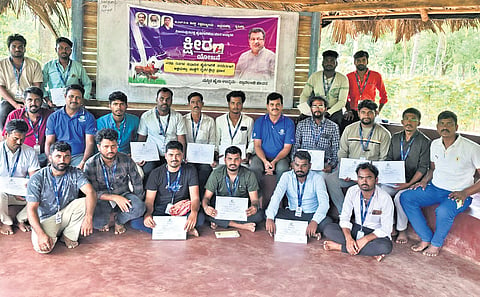

VIJAYAPURA: For 35-year-old Parasappa Ganiger of Kumate village in Babaleshwar taluk, dairy farming was just another traditional occupation till a few months ago.
Like many farmers, he relied upon traditional farming practices and believed that experience alone will help him run a successful dairy enterprise. But a two-day training programme dramatically changed all that. Parasappa now says milk yield from his cows has increased 50%, while the expenditure on fodder has reduced significantly. The training programme was a life-changing experience for him and other dairy farmers from across Vijayapura district.
Parasappa worked as a physical education teacher at a private school earlier. After his dairy started earning him bigger profits, he quit the job and took to dairy farming full-time.
“I believed I was doing well by following traditional dairy farming methods. But after attending training, I realised that many of our traditional practices actually limited milk production,”he said. Darshan Kuchanur, a dairy farmer from Nidoni village, too faced a similar problem. Though he had six cows, the income was not sufficient.
He too attended the training programme, and it transformed the way he managed his cows.“Had I not attended the programme, I would have continued working the same way without any improvement in my income. The programme helped me understand how simple changes can make a huge difference,” Darshan said.
Both are among a growing number of beneficiaries under the ‘Ksheera’ project launched in Vijayapura district six months ago to promote scientific dairy farming and improve rural livelihoods.The project is being implemented jointly by BLDE Educational Institution and Akshayakalpa Foundation, a Tumakuru-based organisation known for its work in sustainable dairy farming and farmers’ empowerment.
Its primary objective is to help dairy farmers adopt scientific methods of cattle management, improve milk production, reduce unnecessary expenditure and enhance their income.
According to Basanagouda Patil, Chancellor, BLDE Deemed University, the initiative was launched after observing that many dairy farmers in Vijayapura lacked access to modern dairy farming and management techniques.
“Vijayapura district has a large number of dairy farmers. But they could not increase the milk yield for want of scientific guidance. We decided to bridge that knowledge gap,” Patil said.
While working on various models to train dairy farmers, Patil ran into Shashikumar, founder of Akshayakalpa Foundation. “After several rounds of discussion with experts from the foundation, we decided to introduce a training programme in Vijayapura district. Our aim was not only to increase milk production, but also to make dairy farming a sustainable and profitable occupation for youngsters in rural areas,” Patil said.
The project was formally launched in November last year under the banner, “Ksheera”. BLDE committed to investing approximately Rs 2.5 crore over five years on the project. Initially, the project was introduced as a pilot in 10 villages with plans to expand it across the district.
Representatives from the foundation prepared a detailed action plan to identify dairy farmers, select local field staff, conduct awareness programmes and organise training sessions. Two trainers were sent to Tiptur in Tumakuru district, where the foundation has devised successful dairy development models. They were trained there extensively and later sent to guide farmers in Vijayapura district.
Groups of farmers from the 10 villages were also taken to Tiptur for training. They were introduced to practical and easy-to-follow techniques aimed at improving animal health and milk production.
Parasappa and Darshan were among the first batches of farmers who were trained. One major area addressed during training was fodder management.
Many farmers believed that providing large quantities of fodder automatically ensured better nutrition for cattle. But the experts taught them the importance of providing the right quantity of nutritional diet to cows. “We learnt that a healthy cow or buffalo needs about 40 kg fodder per day. Earlier, we used to dump fodder in excess before the cows, thinking that more feed meant more milk.
But in reality, much of the fodder was wasted,” Parasappa said. “Before attending the training programme, my six cows produced around 40 litres of milk a day. After adopting the recommended practices, milk production increased to nearly 60 litres a day,” Darshan said. “The amount of fodder I save now is enough to feed at least three more cows. I have decided to purchase two more cows and expand my dairy business,” he said. The success of the project has encouraged BLDE and the foundation to expand it to other villages in the district.
“Many young people migrate to cities in search of jobs because they believe agriculture and dairy farming are not profitable. Our objective is to demonstrate that with proper knowledge and scientific practices, dairy farming can provide a stable and respectable income,” Patil said.
