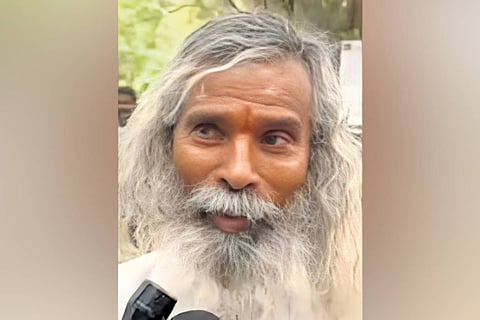

BENGALURU: With slow, deliberate steps, 72-year-old Saibanna N Natikar, his long grey hair and beard reflecting the passage of time, walked out of the gates of Parappana Agrahara Central Prison recently, breathing the air of freedom for the first time in nearly four decades. His frail frame carried the weight of a lifetime of regret - or the absence of it.
Prison officials pointed out that Saibanna was the country’s longest-serving prisoner. DGP (Prisons) Alok Kumar said, “I have interacted with Saibanna earlier when he was in Belgaum prison and at Kalaburagi. His conduct inside the prison was very good.”
Saibanna’s story is one of repeated tragedy. In 1988, he was accused of murdering his first wife, Malkavva, as he suspected her of infidelity. He was granted parole in 1994, after being convicted and sentenced to life imprisonment.
During the break, he remarried, started a new family and became the father of a daughter. But within weeks that new beginning ended in another violence. He killed his second wife, Nagamma, too and their minor daughter, Vijayalakshmi, alleging infidelity. Nagamma too was murdered with a sharp weapon like in the case of his first wife.
Saibanna, who worked in the cooperative sector, said the murders cost him his job and also 10 acres of land that he claims would be worth over Rs 1 crore now. All these years being behind bars, he has maintained that there was evidence of the alleged infidelity of his wives, and he has shown little remorse for the killings.
In 2003, a trial court sentenced him to death for the second double murder, citing the brutality of the crime. The Karnataka High Court later commuted his sentence to life imprisonment. His release came after legal intervention that highlighted he had spent nearly a decade in solitary confinement, which the High Court ruled illegal and inhumane. The delays in deciding his mercy petition also weighed in his favour, leading to his release after 37 years.
Talking to the media outside the prison, Saibanna reiterated that he committed the murders because of his wives’ alleged infidelity. He described the circumstances surrounding both crimes, claiming that in the first one, the man involved escaped, while he killed his wife. In the second case, he alleged that his mother-in-law encouraged his second wife to indulge in infidelity. He did not refer to his suspicious nature or the irreversible pain inflicted on the families of his wives. He said it did not matter if his wife was blind or lame, but what mattered the most for him was her fidelity.
Saibanna thanked Alok Kumar, describing him as a generous and proactive officer. His release reopens the debate on the longstanding questions raised by human rights advocates and legal experts. At what point does prolonged incarceration and unlawful solitary confinement become cruel and inhumane? How should society balance a convict’s age, the years already spent in prison and violations of prison rights against the gravity of the crimes committed?
