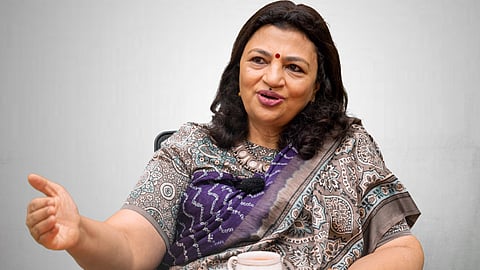

As the state government is contemplating forming a new ministry to address issues pertaining to Non-Resident Kannadigas (NRKs), NRI Forum of Karnataka’s former Deputy Chairperson and MLC Arathi Krishna explains the importance of having such a ministry.
In an interaction with The New Indian Express, she spoke about a range of issues concerning the Kannadiga diaspora.
Excerpts:
There is growing speculation that the upcoming cabinet expansion should provide greater representation to women, give Chikkamagaluru a Cabinet berth after more than two decades, and entrust the proposed NRI ministry to someone with experience. Many believe your name fits these expectations, how do you respond?
I am grateful to party workers and well-wishers for expressing confidence in me. The decision on cabinet formation rests entirely with the chief minister and the party leadership, and I will respect whatever they decide. I do believe women deserve adequate representation in the cabinet, and it is true that Chikkamagaluru has not had cabinet representation for over two decades. If the government creates a separate NRI ministry, my years of working with NRIs, People of Indian Origin (PIOs), embassies and overseas Indian affairs could be useful. If the party feels I can contribute, I will gladly accept the responsibility.
How large is Karnataka’s overseas diaspora?
There are over 30 lakh Kannadigas living abroad. A significant number of blue-collar workers are employed in Gulf countries, while professionals, entrepreneurs and CEOs are concentrated in the UK, the US and other Western nations.
How would a separate NRI ministry benefit Kannadigas abroad?
It would become a single point of contact for overseas Kannadigas. Today, many issues require approvals through multiple levels involving the state government, the Ministry of External Affairs (MEA) and Indian embassies. A dedicated department can coordinate directly with the MEA, while following up on individual cases, ensuring quicker assistance during emergencies such as deaths abroad, evacuations during conflicts or labour disputes. It would also facilitate investments into Karnataka by connecting NRIs with relevant government departments.
What are the major issues faced by Non-Resident Kannadigas?
The problems differ across regions. NRIs in Western countries often face property disputes, fraudulent real estate transactions and matrimonial issues. Many discover that properties entrusted to relatives have been sold without consent, while others become victims of fraudulent marriages. In Gulf countries, blue-collar workers frequently face passport confiscation, contract violations, labour exploitations and financial distress after losing jobs. During crises such as the Ukraine war, Sudan conflict or recent tensions in West Asia, many also require emergency evacuation and consular assistance.
What are your current responsibilities as All-India Congress Committee (AICC) secretary in charge of the Indian Overseas Congress?
As AICC secretary in charge of the Indian Overseas Congress, headed by Sam Pitroda, I oversee organisational activities in 35 countries. We constitute national committees and state chapters wherever there are Congress supporters, coordinate office-bearers and expand membership. I also serve as vice-chairperson of the AICC Foreign Affairs Department headed by Salman Khurshid, where I coordinate interactions between foreign dignitaries and Congress leaders such as Rahul Gandhi and Mallikarjun Kharge. Having previously worked at the Indian Embassy in Washington, I maintain strong contacts with embassies and also organise Indian Overseas Congress events during Rahul Gandhi’s overseas visits.
Can you elaborate on proposed NRI ministry?
Karnataka currently has an NRI Forum, but it has functioned without adequate financial support. During my earlier tenure as Deputy Chairperson, we introduced Karnataka’s first NRI policy based on Kerala’s model and secured the first-ever Rs 2 crore budget. However, that was insufficient to meet growing demands. A permanent ministry with dedicated funding can provide institutional support instead of ad hoc arrangements. I proposed such a ministry in the Congress election manifesto, and the government is now actively considering it.
Doesn’t the Ministry of External Affairs already handle these issues? Why is a state-level ministry necessary?
The MEA plays a vital role, but it handles cases from across India. A state-level ministry can provide personalised follow-up for Kannadigas by coordinating with embassies, the MEA and families. Instead of citizens navigating multiple government offices, they would have one dedicated institution to approach for grievance redressal, welfare schemes, emergency assistance and investment facilitation. That would make the system faster, more accessible and far more responsive.
Can you share your experiences addressing the concerns of NRKs?
I personally coordinated assistance for distressed Kannadigas during major international crises, including the Covid pandemic, the Ukraine war, and the recent Iran-Israel tensions. I also helped evacuate stranded workers, securing passports from employers, negotiating with ship captains to release stranded seafarers, coordinating with Indian embassies for emergency travel documents, facilitating the repatriation of mortal remains from countries such as the UK, and rescuing members stranded abroad.
