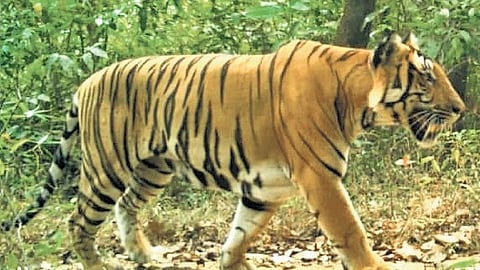

ANKOLA (UTTARA KANNADA): As per the tiger estimation done through camera traps, there are two tigers in the forests of Ankola. Interestingly, these striped cats are migrants —with one from Nagarahole which has covered a long distance over 350 km, while the other from the adjoining Kali Tiger Reserve.
According to the recent tiger census in Canara Circle, the two tigers in Ankola forests were found in Gule and Kotibavi forest areas. Tigers rarely established a home away from home. “Tigers are known to be fiercely territorial. They defend their 6-12 km home range. But of late they have been seen entering the adjacent forests and in a few instances they have travelled hundreds of kilometres,” Kumar Pushkar, Principal Chief Conservator of Forests and Chief Wildlife Warden, told TNIE. He said the use of technology, particularly camera traps, has come in handy in studying such behaviour.
This is the first time in recent years that the presence of tigers has been recorded in Ankola forests. Karwar forests are spread across 118561.352 hectare area, adjoins the Kali Tiger Reserve and has a mix of vegetation of scrub, dry deciduous and moist deciduous, semi evergreen and evergreen patches.
The Ankola sub-division has 24768.411 hectares of forest area and has seven sections which are home to a good number of leopards and sloth bears, and is also rich in herbivores like gaur, sambar, chital, barking deer, porcupine and wild boar, which make a prey base for the felines. Wildlife experts said that such instances have occurred earlier too, but advocated for a systematic study of the dispersal. “There are quite a few such instances where tigers have travelled long distances and established themselves in a distant habitat.

The tigers, particularly the males, do take up such an adventure, but this dispersal pattern should be studied better. We need to have a systematic study of this migration. We need a more scientific approach to this kind of study,” well known wildlife expert K Ullas Karanth said.
There have been four such instances where tigers have travelled long distances. The first one was when a tiger cub was first camera-trapped in 2006 in Bhadra Tiger Reserve and again in Kali Tiger Reserve in 2008, after it had covered a distance 270 km.
Another tiger which mauled a man to death in Gama village near Esoor village, Shikaripura taluk in Shivamogga district, travelled a distance of 280 km from Gundre range in Bandipur Tiger Reserve.
This tiger was released into Bhadra Tiger Reserve, but was killed in a territorial fight a few months after its release. In another instance, a tiger from Maharastra had made Kali Tiger Reserve its home after travelling about 250 km. However the Forest Department points out that the tiger found in Ankola has travelled a distance of 350 km, perhaps the longest distance.
Interestingly, three of the four tigers have moved to Kali Tiger Reserve and made the place their home. Chief Conservator of Forests, Dharwad Circle, Vasanth Reddy, explains, “Kali Tiger Reserve acts as a sink.
The forest area is large and contiguous with the state of Goa’s forest on one side, Bhimgad on another side and even the territorial forest in the district has similarity with the protected forests of Kali Tiger Reserve. Also, there is a good prey density.”