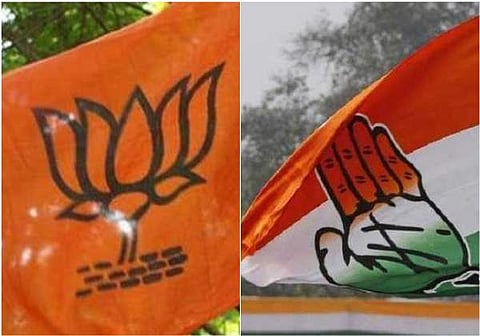

After the leadership change in the government and the party’s state unit, Congress is going full steam ahead in Karnataka. It is building on the initiatives launched since the party came to power in May 2023, while trying hard to shed the anti-incumbency sentiment that was setting in against the Siddaramaiah administration.
Congress is making every possible effort to shape public perception and hold on to power in the state after the 2028 elections, aiming to maintain its political edge over the BJP in South India.ime is running out for the NDA partners in the state. Uncertainties over leadership in the state unit and weak coordination among state leaders within the BJP and with alliance partner JDS have crippled their fight against the State Government.
Although JDS leader and Union Minister HD Kumaraswamy and BJP leaders have been aggressively taking on the government on several issues, they are fast losing the optics war, and an opportunity to be a more effective opposition that holds the government accountable for its actions.
Cross-voting by BJP and JDS legislators during the recent elections to the State Legislative Council exposed the vulnerabilities in the opposition ranks. It caused a major embarrassment to the BJP and JDS leaders and helped DK Shivakumar assert his leadership days after taking over as Chief Minister. In the elections to seven seats, Congress won five and BJP two, while JDS, which had fielded a candidate banking on its alliance partner’s support, drew a blank. The MLAs were the voters in the elections. The fiasco could have been averted by proper coordination between the two alliance parties.
Also, the alliance partners are yet to fully join forces on major issues, including the Bidadi township development project. It has put the State Government in a spot, with a section of farmers strongly opposing it. Shivakumar is believed to be keen on going ahead with the project to decongest Bengaluru, but a section of Congress leaders is wary of the party being branded as anti-farmer.
Senior leaders from the BJP and JDS separately visited the villages to interact with farmers, instead of presenting a strong united front to compel the government to rethink. They should ensure that the township development remains an issue of farmers’ rights and urban decongestion and must convince the government to factor in all aspects, not reducing it to just a Congress versus BJP-JDS tussle.
However, those in the know of the developments in the BJP state unit point out that weak coordination between the legislature party and the state unit is a concern. Many senior leaders do not fully back and extend cooperation to state president BY Vijayendra, while the state unit is blamed for not taking seniors into confidence. Often, subjects raised within the legislature are not taken up with the same force outside. BJP insiders suggest that it’s high time the central leadership ended differences within the party and with its alliance partners to ensure that they work effectively.
During Siddaramaiah’s tenure as CM, the BJP was able to put the government on the mat over several issues: the multi-crore scam in the Valmiki ST Development Corporation in which a minister was forced to resign; the Mysuru Urban Development Authority (MUDA) case in which Siddaramaiah’s family was compelled to return 14 sites allotted to them in a prime location in Mysuru; and the failure to release Rs 5,000 crore in the Gruha Lakshmi guarantee scheme.
However, after Shivakumar took over as CM, the new government is making every effort to bring freshness into the administration and rid itself of the anti-incumbency factor. This presents a new challenge for the opposition.
Shivakumar is already in election mode. He is likely to undertake many initiatives to strengthen the organisation by making its cadre part of the state administration by appointing them to the guarantee committee and other boards and corporations. He is also wooing the youth by announcing grants of Rs10 lakh each to 10,000 Bharat Jodo youth associations to be set up across the state.
The party is said to have identified assembly segments based on various parameters, including candidates’ capabilities to win on their own strength and on the margin of defeat in previous polls, in order to take necessary intervention from now on to win the confidence of voters.
A lot of work is going on in the backend, and the party is significantly ahead of the opposition in planning for the next assembly polls. Congress also appointed AICC observers for districts to strengthen the organisation. While Congress is on the offensive, the BJP is now trying to catch up and regroup by forming a coordination committee with the JDS.
While it remains unclear if the State Government will conduct elections to five corporations in the Greater Bengaluru Authority (GBA) anytime soon, the upcoming bypolls to Hiriyur and Dharwad assembly segments would put the alliance partners to the test before the 2028 polls. Some BJP insiders are of the view that time is running out. Any further delay in making a course correction could make it more difficult for the party to reverse the situation.
Ramu Patil
Deputy Resident Editor
