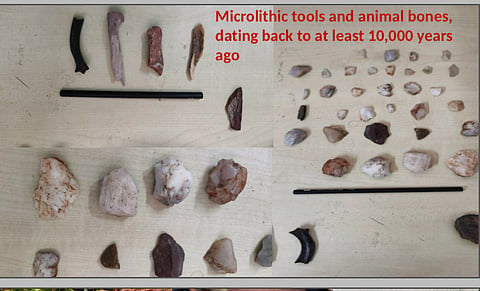

SANDUR (BALLARI) : Archaeologists are claiming that carbon dating has placed one of the caves in Sandur forests here as the oldest cave habitat in a forest ecosystem at 850 metres above sea level in the country, dating back to the Stone Age.
The carbon dating was conducted on a microlith, surface material of a fragmentary human bone recovered from the cave floor, at Physical Research Laboratory, Ahmedabad, in collaboration with Archeology Science Centre of IIT Gandhi Nagar, renowned archaeologist Ravi Korisettar told the TNIE.
The cave site, Rasheed Padi, named after a local ascetic, was brought to the notice of the public in 2024 by a team of archaeological enthusiasts led by Korisettar and environmentalist Samad Kottur as well as associates of the Ballari Heritage Trust and Robert Bruce Foote Sangankal Archaeological Museum in Ballari.
Unlike many other caves, the caves in Sandur forests were not formed of limestones but because of the tectonic uplift of the rocks, said Korisettar.
“We had assumed that the tools found here might be as old as 10,000 years. Radiocarbon dating has now confirmed that this human habitat is 10,000 years old,” he said.
These caves are in located dense forest and exploring them is a difficult task. The team had visited various cave sites in the Sandur forests, including Rasheed Padi, Devadhari Padi, Rama Padi, Bhairava Teertha Padi, near Taranagar; Bhima teertha, Harishankar teertha, near Kumaraswamy temple; Navilu teertha, and Kappara Guppara Swamy Padi.

No place like this in India: Korisettar
“Rasheed Padi has more evidence of early human settlement situated at 850 meters above sea level. This place is surrounded by dense forest. In India, there could be no place like this where early man had settled at such a high altitude. This cave is as high as 100 feet and the floor of the cave is 45 feet. There are many stone implements and animal bones found here to support our claim,” Korisettar said.
“Some of the microlithic implements found here resemble the mesolithic period and the bones found here are believed to be of domestic animals. But we need to take up a lot of studies to ascertain the age of these implements,” he said.
The team had also found some bones and teeth relics of wild animals. These will be subjected to further carbon dating. “After the finding of the caves in 2024, the question loomed large when the early man entered the area searching for basic economic resources such as plant food, game animals and suitable rocks for preparing stone tools to facilitate their subsistence strategies was not known. The answer has come now,” said Korisettar.