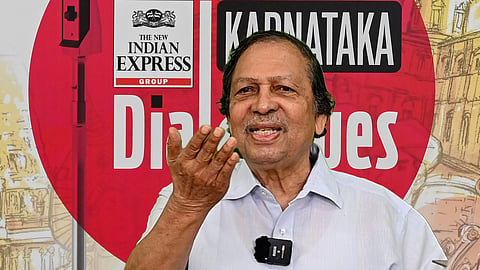

Greed is the root cause of corruption and only contentment and humanism can change things for the better, opines anti-corruption crusader and former Karnataka Lokayukta Justice N Santosh Hegde.
In an interaction with TNIE, he shared his thoughts on various ongoing issues such as the Bidadi Township Project, SIR, registration of RSS and others. Excerpts.
You are an icon of the anti-corruption crusade in Karnataka. What brought you to this path?
I was born in a middle-class agricultural family. My father was the only one with a higher education degree. I did my schooling in Mangaluru and then followed my father to Bengaluru; I pursued law and joined the bar in 1965. In 1984, I was appointed Advocate-General of Karnataka. I resigned because the income was not adequate.
Within a year, the Central government invited me to be Additional Solicitor-General of India. The then prime minister Atal Bihari Vajpayee appointed me as Solicitor-General, a post that none else from Karnataka has held till date.
Later, to fulfil my late father’s desire, I accepted to become a Supreme Court judge, and worked till 2005. In 2006, the Karnataka government invited me to be appointed as Lokayukta. I took up the offer, to do whatever I could to help prevent the prevailing sickness (corruption) in the country.
How independent was the Lokayukta while handling cases?
Lokayukta fights corruption through the police force assigned to the Lokayukta, and not independently. All cases need to be investigated by a police officer, not below the rank of deputy superintendent of police. I was happy as I had some very good officers. These were sent (to the Lokayukta) by the government as they did not listen to politicians. We investigated three chief ministers in Karnataka and indicted them. One of them was taken from his office to jail. Unfortunately, none of them was prosecuted.
How do you view the issue of corruption among political leaders?
One of the three chief ministers had taken Rs 20 crore by cheque. There is a rule that no government servant shall receive more than Rs 100 as gift. He was arrested but he didn’t stay in jail for more than 24 days, and no case was filed. That’s how things work. The government hesitates to prosecute their own colleagues. Though I retired in 2011, some of the cases from back then are still pending.
How has your work been recognised over the years?
I got 14 to 15 awards along with cash by various organisations. One institution honoured me with Rs 1 crore, but I requested that it be donated. They insisted that it was my award to use as I chose, so I gave it to the Indian Army completely. I have not kept a single rupee of any of those awards.
What is the root cause of corruption?
Greed is the root cause of corruption. Some people in power, in significant departments, suffer from this disease, and there is no limit to their greed. These people are always dissatisfied and feel the need to earn more. Greed is normalised by society. There is nothing wrong in being rich, it is wrong when wealth is acquired by what rightfully belongs to others.
Where do you think change should begin?
It should begin with the youth. Changing adults is difficult, but children can still be taught values. When I was young, my parents taught me values. Earlier, Moral Science was a part of education. Today, the focus is on wealth rather than character building, and that needs to change.
What are the values that need to be inculcated?
Contentment and humanism are essential. Without humanism, one becomes a zombie. You go to any hospital, you have to pay money first, to even get admitted. When people learn to be content with what they own and treat others with respect and compassion, society will become more ethical and harmonious.
Can you share an experience that had a lasting impact on you?
As the then Lokayukta, I came across a six-month-old child who was born without a rectum. The family could not afford the surgery. I helped support her treatment and the child was successfully operated upon. Today, she is a grown up girl, and has a bright future ahead. It was one of the most fulfilling moments of my life.
What changes did you implement in the Lokayukta?
I was appointed as Karnataka Lokayukta in 2006. We started, for the first time, a 24-hour emergency call centre so that calls can be made at any time of the day. Fortunately, the practice still continues. People can get relief from the Lokayukta. Some public servants make decisions based on selfish motives, not public relief. I have seen bribes being taken to return dead bodies. Corruption has become the norm. “Everybody does it,” is the attitude today! Lokayukta’s job is a wonderful job, but it takes a lot from the person running the institution. Lokayukta has two important roles -- fighting corruption and addressing the problems of the common people. Both are equally important.
The powers of the Lokayukta have been since diluted. What is your opinion?
Some of the powers were taken away as the government felt challenged, seeing to what extent the Lokayukta can go. One power has been returned on public demand, however, it’s not the same as it was before.
Tell us about your post retirement life?
After my retirement, I joined Anna Hazare’s organisation ‘India Against Corruption’ to continue my fight against mismanagement. Along with me there were many politicians, one of them was Arvind Kejriwal. They came to me saying they were forming a political party and invited me to join politics. I chose to stay away from it.
What do you think of the Bidadi Township Project?
Bidadi is already a developed city. I went there for the first time 3-4 days back. It is fully industrialised. A couple of motor companies are manufacturing vehicles there and other engineering work is also going on. However, they still want to expand. Around 7,000 acres of farmland is being acquired, displacing thousands of farmers and leading to felling of nearly seven lakh trees (coconut and cashew). This is being done to get AI industries in Bengaluru.
Can these industries not be set up in locations that do not affect people and the environment? The government has thousands of acres of land which is not occupied by anybody. I searched on Google to see how long it takes for a coconut tree to grow: it’s around 5-7 years. What shall the person do during those five years? What about his income and where will he get another readymade piece of land to start his cultivation? It is really unfair for farmers to wait for long periods in order to regain their losses due to large-scale industrial development.
What is the impact on the ground?
Thousands of families have been evicted from their lands, where their families had been staying for hundreds of years. One cannot artificially make food.
The government is now planning a tunnel road project to address Bengaluru’s traffic congestion, similar to the earlier steel flyover proposal. Do you think a tunnel road is the right solution?
While I agree that traffic congestion needs to be addressed, I feel such projects require careful consideration. The first concern is safety because the quality of construction nowadays is poor. There are also concerns about corruption in large infrastructure projects.
Recently, Chief Minister DK Shivakumar announced an anti-corruption helpline for the state. What do you think about it?
It is a good idea. However, it would be even better if politicians also changed their mindset. Politics was meant to be public service, not employment, but unfortunately that has changed.
There has been a demand from a section of political leadership that the RSS should be registered. What is your view?
Freedom of association is a Fundamental Right under Article 19. Unless a specific law mandates registration, an organisation cannot be compelled to register simply because a minister says so. Governments have banned the RSS in the past, but those bans were withdrawn because courts did not uphold them.
Can the state government bring in a law making such registration mandatory for organisations like the RSS?
They can enact a law, but they must justify why only such organisations should be singled out. Any such law will have to withstand Constitutional scrutiny because the right to form association is a Fundamental Right.
Why are youngsters not becoming part of politics?
Today’s political system is largely controlled by established political families. The qualification often appears to be whether your father is an MLA or minister rather than merit. Dynastic politics has become the norm, making it difficult for ordinary young people to enter politics.
Why is there no proper qualification to become a politician?
There is no educational qualification required to enter politics. In contrast, most government jobs have clearly defined qualifications and require candidates to meet certain eligibility criteria, including a clean record. However, in politics, even individuals facing criminal cases can continue to hold public office. In some cases, criminal charges are even projected as a mark of struggle or political credibility.
Recently, Lokayukta SP-1 Shivaprakash Devaraju was repatriated from the Lokayukta before completing his one-year tenure, despite the fact that he had conducted some good raids and traps. What are your views?
It is a very unfortunate. When the law mandates a minimum of three years, emergency transfers should be given credible reasons.
When it comes to prosecution sanction, many officers are off the hook because the Home department doesn’t give sanction.
When Article 14 says there shall not be discrimination between one group and another group, you cannot have any difference. What is the difference between an ordinary citizen committing a crime and a public servant committing a crime? Why should you have permission from the appointed authority to be prosecuted? What also happens is that the sanctioning authority does not have evidence before him and there are no arguments placed before him for granting sanction for prosecution. The need for sanction is a British legacy. It should be done away with. The requirement of sanction is malicious.
There is a lot of discussion around the SIR. What do you think about it?
Of course the effort is good because I am told that over the decades, a large number of immigrants have registered themselves as voters even though they are not citizens of this country. Even (political) candidates help them because they want their votes, but the entire process (SIR) is very hard. There are so many questions asked, documents from 2002 are sought. Who keeps such old documents?
What is your message to society, particularly youngsters?
My experience at the Lokayukta has taught me that greed is one of the main causes of corruption and injustice. I believe this is partly due to the decline in value-based guidance within families. When I was young, my parents taught me the difference between right and wrong, and corrected me whenever I made mistakes. Those lessons shaped my character and taught me accountability.
Today, many parents hesitate to discipline or guide their children, and as a result, moral values are gradually eroding. While every young person should have ambition and strive for success, those goals must always be achieved through honest and lawful means. True happiness comes from contentment — being satisfied with what you earn through integrity while continuing to work hard for a better future.
Another value I believe is equally important is humanism. Young people have the power to build a better society by choosing honesty over shortcuts and empathy over selfishness. If they uphold the values of integrity, contentment and humanism, India can become a more just, peaceful and corruption-free nation.
