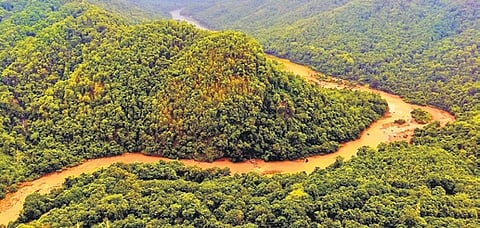

BENGALURU: Experts and conservationists have expressed concern over the newly released Master Policy Blueprint: The National Policy for Conservation of Western Ghats, prepared by the Karnataka State Western Ghats Conservation Taskforce. Terming it unscientific, they have demanded an open dialogue with the aim of conserving and protecting the Western Ghats.
Prof TV Ramachandra from the Centre for Ecological Sciences, Indian Institute of Science (IISc), said, “It is an unscientific report and does not support conservation. The taskforce cannot speak or touch forests in other states as they are out of its ambit. Further, this has been drafted without any ecological and hydrological integrity. The Gadgil and Kasturirangan reports were prepared after consultation with stakeholders, citizens and multiple organisations.”
He said protection of water bodies, particularly streams and rivers, is crucial as they support the entire ecology of peninsular India. They play a crucial role in the agriculture and economy of the country, besides weather and climate control.
Allowing hydel and hydro projects will be disastrous, mining, quarrying and road works will lead to further landslides, mudslides and other havoc. Lessons have not been learnt from recent incidents in Karnataka and Kerala, Ramachandra added.
A conservationist and petitioner in the Supreme Court said, “We need to protect the Western Ghats to support the ecosystem, ecology and local economy, or it will lead to diseases like monkey fever and more man-animal conflict, which has not found place in the document.”
Another conservationist working with the government, requesting anonymity, said, “The document has been prepared to please government agencies.
They have not realised that the Eco-Sensitive Zone (ESZ) is under the Environment Protection Act and is not a state subject, just like the Wildlife Protection Act. No alteration can be done to the ESZ as it is listed. The state has no jurisdiction is announcing or altering ESZs.
Similarly, Western Ghats is a declared Unesco-protected site and biodiversity hotspot. The state government cannot undertake projects in the region. Furthermore, it cannot take any decision independently. This policy can be challenged in court.”
The conservationist added that there is no mention of the forest department and pollution control boards, which again come under the Ministry of Environment, Forests and Climate Change.
Multiple Supreme Court orders on corridors and other issues, including ecological sensitive areas, have not been considered while formulating the policy, hence it stands no ground.
