
BENGALURU: The State Finance Commission suggested that the State Government reduce its committed expenditure, rationalise growing salary expenditure, and improve the efficiency in the implementation of the schemes.
The report stated that the salary proportion in total Non-Scheme Committed Expenditure is 50.4%. The growing salary expenditure needs to be rationalised. “With the introduction of the 7th Pay Commission Scales, performance assessment has to be made stringent and identify unnecessary cadres/staff in departments that have been rendered redundant. Formulate an effective HR policy and adopt different hiring practices as per the requirements,” the report recommended.
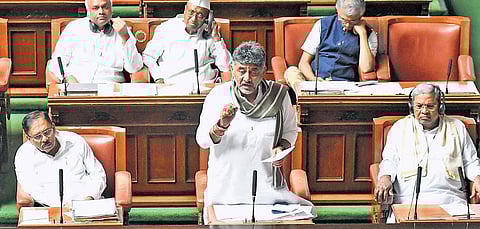
The fifth State Finance Commission report, tabled in the Assembly on Tuesday, stated that the share of interest payments in Revenue Expenditure will increase from 14.6 % in 2025-26 to 16.69 % in 2029-30, indicating an increased burden of debt liabilities. Rationalisation of expenditure and augmenting the state revenue will reduce the debt burden, the report added.
On increasing Non-Tax Revenue, the report suggested exploring new areas in tourism, mining, and advertising. “Stricter enforcement, including periodic tariff revisions for public utilities like water and sanitation charges, parking fees, transport, and urban services, etc. Improving tax administration through digital tracking, automated billing, and tighter compliance to reduce leakages. The government can also explore the revenue generation possibilities through asset monetisation, as it has high potential,” it added.
The Finance Commission stated that the five guarantee schemes are likely to produce a multiplier effect on income and employment in the short run, however, in the medium and long run, much depends on their impact on investment and development expenditure.
Innovative measures are essential for mobilising resources to meet the five guarantees, it said, and suggested that the state must build state-of-the-art infrastructure for future growth, centered around investment in human resources, industries, innovation, research and development, which are the fundamental factors for robust growth in the future.
On the revenue deficit, the commission stated that it needs to be addressed through strategic measures to increase revenue and reduce expenditure, thereby mitigating its impact on rapidly expanding economic activities in the state. The report stated that the state should increase Capital Expenditure and adopt a switching mechanism to reallocate resources from consumption to production to sustain the higher level of GSDP and undertake necessary measures to improve infrastructure, adopt an investor-friendly policy, and improve Ease of Doing Business.
Growing urbanisation
The report stated that by 2036, 50.75% of the total population will be living in urban areas in the state. This will create pressure on demand for urban services and the need for more devolution of resources to attain the Service Level Benchmarks (SLBs) in urban areas.
“Over the period, economic growth has become highly concentrated in Bengaluru, leading to increased migration, environmental degradation, and a higher demand for services. There is an urgent need to promote growth in Tier II and Tier III cities by developing adequate infrastructure and services. The devolution of resources needs to be guided by these emerging issues,” the report stated.