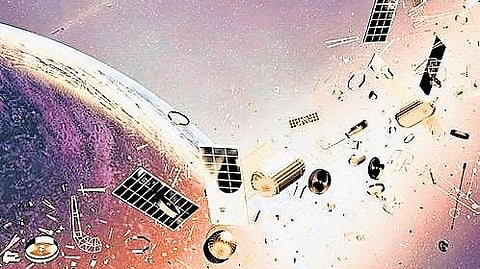

BENGALURU: As of March 2026, the growing presence of space debris linked to Indian satellite missions has raised serious concern among scientists and space agencies worldwide. A total of 129 trackable debris objects currently remain in orbit, originating from India’s space activities. The information was tabled in the Parliament on March 18.
These include defunct satellites as well as fragments from launch vehicles. The largest share of this debris comes from Polar Satellite Launch Vehicles (PSLVs), accounting for 40 objects.
Notably, 33 pieces have been identified as resulting from the in-orbit break-up of the PSLV-C3 rocket. In addition, there are four debris fragments from Geosynchronous Satellite Launch Vehicles (GSLV) and three from Launch Vehicle Mark-3 (LVM3). The information also stated that the debris also comprised on 23 defunct satellites in the Low Earth Orbit (LEO) and 26 in the Geostationary Equatorial Orbit (26).
The Indian Space Research Organisation (ISRO) along with other stake holders launched the Debris Free Space Mission, to ensure zero debris creation from Indian satellites by 2030. ISRO stated that it annually releases the Indian Space Situational Assessment report which contains information of the assessments.
However, the report is with the PMO, sources said. The ISRO is yet to release the findings of the failure of the PSLV-C61 and C62 that happened in May 2025 and January 2026, respectively. These failures and the piling space debris become major challenges and setback for the organisation, source added.
Scientific work for clearing the debris has also started. The Ministry of Earth Sciences said India is aligning debris mitigation with Inter-Agency Space Debris Coordination Committee and United Nations Committee on the Peaceful Uses of Outer Space, with ISRO ensuring extra fuel margins in launch vehicles.
Scientists are lowering their orbits after the end of the missions to help in the re-entry into the Earth’s atmosphere within a shorter time. The required fuel for de-orbiting is being accounted for in the design phase itself.
ISRO teams added, studies are also being undertaken for the creation and usage of robotic arm, rendezvous and proximity operations that will help in the removal of debris. ISRO pointed that it has undertaken the Network for Space Objects Tracking and Analysis (NETRA) project and the expenditure of Rs 67.76 crore has incurred from the sanctioned Rs 509.01 crore.
