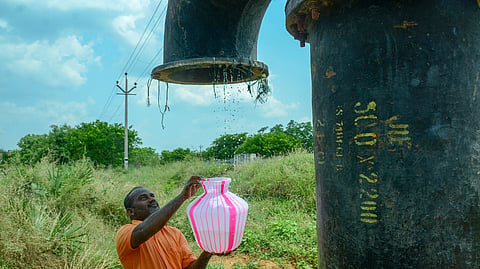

MYSURU: Soaring summer temperatures could precipitate a drinking-water crisis across the state. According to the latest report by the State-Level Weather Watch Committee, 207 taluks are expected to face water shortage this summer, while 60 taluks are already in the midst of water scarcity. In addition, 2,258 gram panchayats have been flagged as vulnerable, with 212 panchayats currently experiencing acute water scarcity.
Among the state’s 31 districts, the worst-affected taluks are concentrated in Uttara Kannada (12), Belagavi (14), Kalaburagi (11) and Tumakuru (10). At the gram panchayat level, Kalaburagi accounts for 180 affected local bodies, followed by Uttara Kannada (170), Haveri (138), Mandya (130) and Belagavi (126).
To mitigate the crisis, authorities have deployed four departmental water tankers and 56 private tankers. They have also engaged 270 private borewells to sustain supply, from where water is being delivered to 246 villages.
During the peak summer season of March to May, authorities anticipate above-normal maximum temperatures in most parts of the state. Above-normal heatwave days with positive anomalies – ranging from three to six days – are likely over much of the north-interior districts and in select pockets of south-interior Karnataka, including Kolar, Chikkaballapur, Bengaluru Rural and Bengaluru Urban.
Authorities said a transition from La Niña to ENSO-neutral conditions is expected in April, with ENSO-neutral conditions likely to prevail through May to July. From June to August, El Niño is expected to emerge (62% chance) and persist at least through the end of 2026.
The shift from a dissipating La Niña phase toward ENSO-neutral conditions is already under way. There is a high likelihood (70%) of El Niño developing between June and September.
Meanwhile, the state faces an elevated risk of “monsoon breaks” – prolonged dry spells – during peak months of July to August with the potential for substantial moisture deficits resulting in below-normal rainfall in the Krishna and Cauvery basins.
El Niño conditions to cause rain shortage
C Govindaraju, professor at the University of Agricultural Sciences (UAS), told TNIE that the emerging El Niño conditions could translate into rainfall shortfalls for the state. “High temperatures will adversely affect agricultural operations. Water scarcity may also force wild animals to venture into human settlements in search of food and water, and there could be a rise in the incidence of disease among people,” he said.
Loss of property till March 23
Human loss due to lighting : 5 (one each in Bidar, Gadag, Koppal, Raichur and Vijayanagar districts)
Human loss due to house/wall collapse: 1 (Belagavi district)
Animal and crop loss from March 15 to 23
Big animal loss : 16 -- Dharwad (6), Hassan (1), Koppal (1), Kalaburagi (2), Mysuru (2), Raichur (3), Vijayapura (1)
Small animal loss : 116 -- Bagalkot (41), Belagavi (39), Dharwad (32), Gadag (4)
Agriculture crop loss: 1,700.33 hectares -- Bagalkot (743 ha) maize, wheat, sugarcane, Ballari (602 ha) paddy, Belagavi (106 ha) maize and wheat, Chamarajanagar (27 ha) sugarcane, Chitradurga (4.05 ha) maize
Four dists to suffer most
Among the 31 districts, the worst-affected taluks are concentrated in Uttara Kannada, Belagavi, Kalaburagi and Tumakuru
